Inflation Came In Soft. Stocks Cheered. Crypto Found Out Its Biggest Fan Sold Again.
Sunday said two inflation reports would decide the week. Both came in soft, exactly the outcome that should have helped Bitcoin the most. Stocks got the message and rallied. Bitcoin fell anyway. Two things explain why. A filing revealed the single largest corporate holder of Bitcoin sold again last week. The ETF fund buyers who showed up the week before reversed course and pulled money out instead. Iran hardened its terms midweek rather than softening them. Here is the full week.
The data got better. Bitcoin’s own buyers did not show up for it.
Softer inflation and better rate odds are exactly the kind of week that normally lifts everything that benefits from lower rates. Stocks got that memo and the Nasdaq 100 gained on the week. Gold and silver ended slightly higher. Bitcoin and Ethereum both fell. Oil was on its own path entirely, popping on Middle East tensions before settling back as the fatigue story took over again.
So this was not a bad week for the macro backdrop. It was a bad week specifically for Bitcoin, isolated from everything else tracked here. That points at a crypto-specific explanation, not a market-wide one, and Section 03 has it.
Grading Sunday’s calls against what actually happened.
Bitcoin’s most reliable buyer sold instead of buying, for the second week running.
Monday, before either inflation report even landed, Strategy disclosed it had sold more Bitcoin last week. This is the company built almost entirely around buying and holding it.
It sold 1,690 Bitcoin for about $109 million, at a price below what it originally paid, to fund a buyback of its own preferred stock rather than add to its pile. It has not bought any Bitcoin at all in nearly two months, the longest pause since Saylor started this strategy years ago. Strategy has spent years being the most consistent, highest-profile buyer Bitcoin has ever had, so a shift like this is a real change in who is providing support underneath the price.
The timing lines up too well to ignore. That same Monday, Bitcoin funds logged their worst single outflow of the week. Investors who had been buying for five straight days the week before pulled back hard the moment the largest known holder was shown to be selling again. Full numbers in Section 07.
Both engines from Sunday held. Iran just took the scenic route getting there.
The labor market engine worked exactly as described. Two soft inflation reports backed up the labor numbers and confirmed the Fed has less reason to raise rates, and the odds of the Fed just holding steady moved further in that direction rather than merely holding where they started.
The Iran engine got there too, just not smoothly. Instead of fatigue on all sides easing tensions in a straight line, Iran hardened its position midweek. Reports described new terms that would ban American and Israeli ships from the Strait entirely, and demand compensation for war damage before any blockade lifts, well beyond a simple traffic agreement. Oil spiked hard on the news, then settled back down as the story cooled again. The fatigue thesis was not wrong. It just was not a straight line.
The chain’s logic held. The size of the reaction did not. That gap between what should have happened and what did is usually where the more interesting story is hiding, and this week it was Bitcoin’s own buyers stepping back, not the macro data.
The rotation spread closed a week below its entry level for the first time.
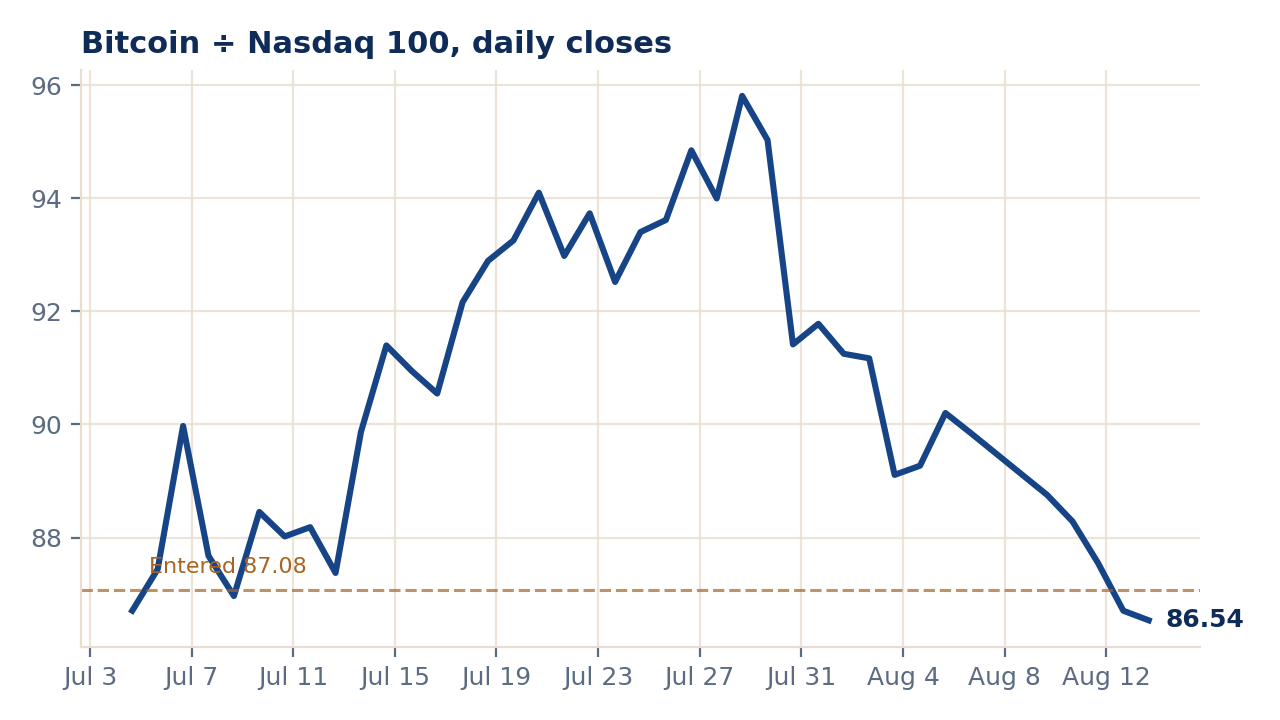
The Bitcoin against the Nasdaq 100 spread from Lesson 7 fell to 86.54 this week, below the 87.08 level it was entered at back on July 3. It traded under that level briefly in the first week after entry, but this is the first time it has closed a week there. That is also the second straight weekly decline. The stated exit needs sustained tech outperformance over multiple sessions, and two weeks is not that yet, but it is worth watching closely.
Crypto fell, everything else drifted, and the leverage data tells its own story.
Last week’s buyers left as fast as they showed up.
Money flowing into a Bitcoin fund usually means buyers are winning. Money flowing out means sellers are. Last week, five straight days of buying brought in close to a billion dollars, the best stretch since April. This week flipped: roughly $200 million left over three days, with the worst single day landing on the same Monday the Section 03 news broke. Ethereum’s funds told the same story on a smaller scale.
A volatile week that ended almost exactly where it began.
The CLARITY Act had a genuinely choppy week. It fell to a fresh low near 14% early on, spiked above 27% around the procedural news from last Saturday, then faded back before settling at 21% tonight, barely different from where it stood a week ago. The path was volatile. The destination was not. Congress remains out until September 14, and nothing this week changed that timeline either direction.
The macro backdrop and Bitcoin’s own supply and demand are telling different stories right now.
The rate backdrop keeps improving, but that has not translated into price this week, and the reason is specific: the largest known holder selling and fund buyers stepping back at the same time. That is worth separating from a genuine change in the macro case, which has not actually deteriorated.
Bitcoin’s funding rate rose while its price fell, meaning leveraged longs paid more to hold a position that moved against them. That is either genuine conviction the selling is temporary, or traders caught on the wrong side and staying in anyway. Worth knowing which camp you are in before adding here.
This week is a genuine example of the macro story and the asset-specific story pulling apart. A better rate backdrop did not show up in the price because the marginal buyer was not there. Worth watching whether that is a one-week gap or the start of something that lasts.
Whether the largest holder’s selling continues, whether fund flows recover, and where the Iran story actually lands all carry into the weekend. Opener 11 picks up from here.
The roll happened this week. The August $70,000 call had decayed to almost nothing, so it made sense to buy it back and sell the September $70,000 call instead, same ceiling, more time on the clock. That roll brought in roughly $730 on its own, on top of the $1,200 collected at entry, for about $1,930 in total premium banked so far. Bitcoin itself has gained $976 since the $62,500 entry. Together, this position has generated close to $2,900 in about five weeks. It did that through a week where Bitcoin itself was down.
Read the Lesson →Charted in Section 05. A second straight weekly decline, and the first week the ratio has actually closed below where the trade was entered, is the kind of development the lesson’s exit rules were written for.
Read the Lesson →Quick read on the self-directed borrow, or the self-directed earn, same strategy from different sides, this week: perpetual funding moved higher, and the futures basis ticked up too, but not by as much. Funding is still running hotter than the basis, so the trade stays tilted the same way it has been: borrow your exposure using the expiration futures contract, and lend it out on the perpetual side, collecting the richer funding instead of paying it.
Read the Lesson →This content is produced by Harmonic for educational purposes. It is strategy education, not investment advice.