The Fed Got Its Family Fight. The Dollar Lost 100. The AI Earners Won.
The Fed's own rate-setting voters, educated delinquents that they are, got into a real fight this week over whether to hold or hike, and held anyway. The economy grew slower than expected while prices stayed stubbornly high, a combination nobody wants. Japan bought its own currency since nobody else would, and knocked the dollar down off a level it had held for a month. Microsoft is the landlord collecting AI rent. Meta is the tenant complaining about the bill. Bitcoin did not notice any of it.
A hike is still the base case, and it took a foreign treasury to move the dollar.
Six calls. Five landed. One surprised early.
5 called · 1 surpriseChina built the machines we spent years keeping out of its hands.
We have been blocking China from the advanced tools needed to build cutting-edge AI chips, to keep them from competing with us. This week China built its own version anyway.
A state-backed firm in Shanghai is now producing the machines that etch circuit patterns onto chips, the exact category the export ban was written to stop. Markets took it seriously: South Korea had to pause trading on its own exchange, and two of its biggest chipmakers each fell more than 13%.
The machines still lag the best in the world and still need Japanese parts to run, so this is not parity. But years of export controls were answered inside a week. The embargo bought time. It did not buy a permanent lead.
The market stopped giving AI spenders the benefit of the doubt.
Some companies are profiting from the AI buildout and others are spending enormous sums on it, and the market just started judging the two groups very differently. Microsoft and Amazon are the earners, they sell the cloud computing power everyone else needs. Meta is the spender, pouring money in with results still to come.
This week both earners were rewarded and the spender was punished, even though its underlying business is fine. That is the same tension that showed up in smaller names two weeks ago, now running at full scale across the biggest companies in tech. Charted in the live book below.
The chain tried to reverse. Iran stopped it. Then the dollar broke.
Oil was at $84. The diplomatic pause looked like it might hold. It did not.
Monday afternoon Iran fired missiles at US forces. All were intercepted, but the ceasefire that was supposed to fix everything lasted five days. Oil reversed hard, up more than $5 in one session.
Thursday's growth numbers explained why the Fed was fighting: the economy grew slower than expected while prices stayed stubbornly high, the exact uncomfortable combination that leaves no easy answer. Slowing growth argues for holding. Stuck inflation argues for hiking. There is no single move that answers both, which is why the room split.
Then Thursday morning Japan intervened. Billions changed hands in minutes and the dollar gave up a month of steady gains in one session. The week opened with Iran breaking the ceasefire and chip stocks selling off. It ended with the dollar taking a real hit and risk assets rallying on the news.
Same framework, opposite directions, same week. The chain ran forward Monday when Iran broke the ceasefire. It ran in reverse Thursday when Japan's own intervention knocked the dollar down.
Read the Lesson →Where the trades from the lessons stand tonight.
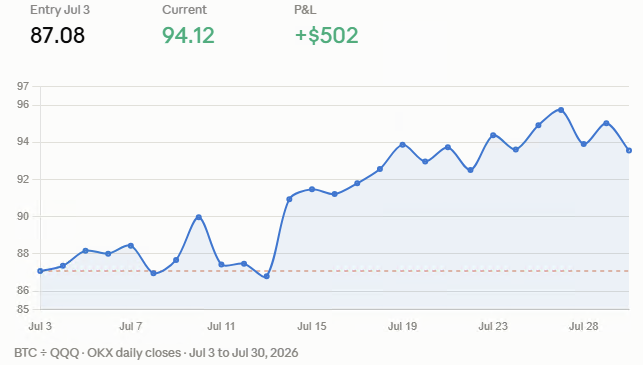
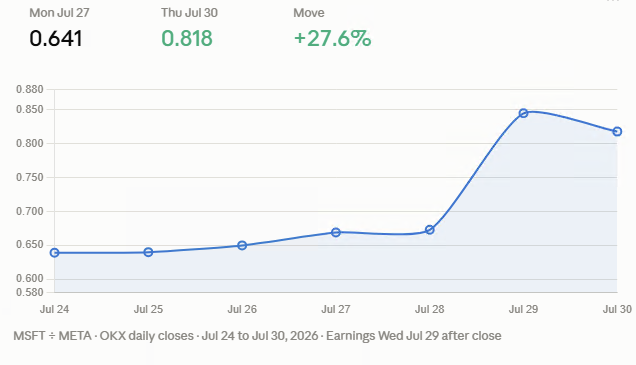
The rotation spread first. It never needed a call on direction, just the relationship between two things moving apart. The chart next to it runs that same logic on Microsoft against Meta instead of Bitcoin against the Nasdaq, and moved even further: 27.6% against the rotation spread's 8.1%.
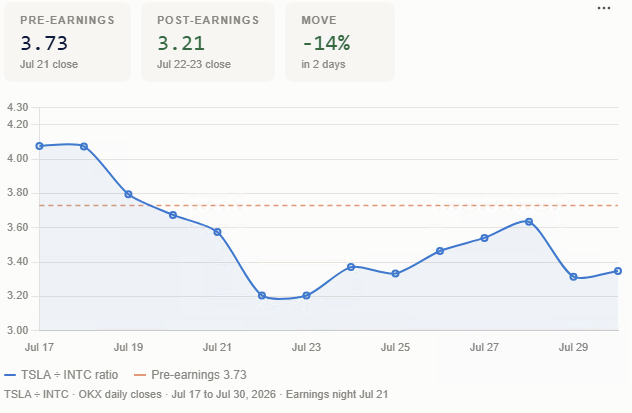
The TSLA and INTC version Closer 7 ran is the same trade in smaller names, and it is the cleanest illustration of why the spread works. It did not need Tesla to fall or Intel to rise. It needed earnings night to sort the two.
7-day funding at 3.81% against the September basis at 3.87%. The spread that pays this trade is essentially closed. Today’s rally spiked the 1-day number but the structural gap has not reopened. Watch the 7-day. When it holds above basis the trade earns again.
Read the Lesson →The August contract on Deribit at $65,002, up 4% from the $62,500 entry. Position up $3,086. The August $70,000 call marks at $615, and rolling to $72,000 costs $129. Upper trigger at $65,625. Japan's central bank decision and a wage report both land Friday, so make the roll decision before then.
Read the Lesson →How to build a spread, size both legs, and define the exit before you enter.
Read the Lesson →The week in numbers. Sunday opener price to Thursday close.
WTI at -12.36% on the 7-day means the derivative market has stayed short oil for weeks with Iran active, so the squeeze risk sits above $86, not below. QQQ at 11.70% against SPY funding at zero says the leverage is in tech alone. That is concentration risk, not a bull signal.
Four days of outflows. Bitcoin held. One day of inflows. On Fed day.
A Bitcoin ETF is a fund that lets big investors get exposure to Bitcoin without holding it directly. When money flows into the fund, that usually means institutions are buying. When money flows out, that usually means they are selling. Watching that separately from the price tells you whether a move is being driven by real buying and selling pressure, not just noise. This week: four straight days of money flowing out, nearly half a billion dollars total, and Bitcoin barely moved, down about half a percent. That mismatch is the real signal. If institutions were selling that much and the price barely budged, someone else was buying every dollar of it. Then Wednesday, the day of the Fed decision, the flow reversed and money came back in. A hawkish Fed and real internal disagreement, and buyers still showed up anyway.
Dollar broke 100. September hike still 63.4%. Figure it out.
Bitcoin absorbed Iran, three Fed dissenters, a GDP miss, and four straight days of ETF selling, and finished flat. A week that ugly producing a half-percent move is the whole signal. Thesis intact.
September hike odds fell all week and still sit as the most likely outcome, even with growth coming in weaker than expected. Normally a growth miss like that brings rate expectations down. This week it did not, because prices are still stuck too high for comfort. Several Fed voters are on record wanting a hike anyway. Japan's finance ministry reminded you the biggest moves come off the calendar, not on it. September 16 is a binary event. Size accordingly.
Dollar gave up 100 in a single session. Tech longs are paying up to hold exposure while gold longs pay a fraction of it. The market is buying the tech recovery thesis, not the safe-haven trade. Both spreads in the live book are working and Bitcoin took a week of ETF selling without breaking. If you have been waiting for confirmation, this is it.
Japan's central bank announces Friday morning. Its finance ministry already knocked the dollar down this week, but the interest rate gap between the US and Japan that caused the weak yen in the first place is still wide open. A hawkish statement and the yen move holds. A non-committal one and it reverses. The wage report lands the same morning. The crypto industry's push for regulatory clarity has cooled on prediction markets, down from 38% to 30% odds of becoming law this year, with August 7 the last chance before lawmakers leave for recess, so nobody is sprinting.
This content is produced by Harmonic for educational purposes. It is strategy education, not investment advice.
Both issues, every week, delivered as clean PDFs you can read anywhere: