Two Companies Beat and Got Sold Anyway. The Fed’s Panic Faded. Crypto’s Bill Ran Out of Runway.
Two more companies proved that beating expectations isn’t enough anymore. The scare started Friday, when the Employment Cost Index, the Fed’s favorite number for tracking wage inflation, showed pay rising faster than expected. That report had traders betting hard on a rate hike heading into Sunday’s Opener. This week that bet unwound. Hiring came in weaker than expected, and the fear faded with it. Iran made real, verifiable progress without producing an actual deal. And the CLARITY Act, Congress’s attempt to set clear rules for crypto, ran its clock down to a single procedural question. The jobs report lands after this goes out, so that part waits for Sunday. Here’s what already happened.
The rate hike scare cooled, buyers came back, and beating estimates stopped being enough.
Bitcoin climbed to $64,267, up 1.4% on the week, a solid but unremarkable gain next to the real story on the board: gold and silver both up sharply, outrunning every other asset tracked here. Every permanent asset finished green except oil, which fell as Iran talks made real progress. That is a genuinely calm tape for a week that opened with a Fed panic and closed with two high-profile earnings selloffs.
The Fed story eased for a boring reason: weaker hiring gave the Fed less reason to hike. Full chain in Section 04.
Grading Sunday’s calls against what actually happened.
Beating expectations stopped being enough, twice in one day.
Last week, Meta beat on revenue and still got punished for its spending. This week the pattern ran twice, on two different companies, the same night. AMD beat on revenue, profit, and outlook, and still fell hard after hours. SpaceX beat on revenue by a wide margin and lost less than expected, and fell hard too. Good is no longer good enough here.
The reasons differed. AMD’s problem was profitability: ramping up its newest AI hardware squeezed margins below what investors wanted. SpaceX’s problem was scale: its AI infrastructure spending came in far above estimates, and after other tech giants already spooked investors on AI spending this earnings season, the market had zero patience left.
The takeaway for the earner-spender idea from Closer 8: it is not just about picking the right side anymore. Even genuine earners get punished now if the market smells spending that outpaces the payoff. That is a market getting pickier, not a market turning bearish. Bitcoin, notably, did not flinch through any of it.
Sunday’s two engines both ran out of steam. Here is why.
Sunday described two engines pushing risk assets lower: hot inflation pressuring a Fed hike, and a currency intervention squeezing the cheap-yen trade funding tech buying. Both lost power this week for the same reason: weaker hiring took the pressure off the Fed.
Exactly the release valve Sunday described, working as intended. That does not mean it is over: the Iran talks have not produced an actual deal, and one weak hiring print is not a trend.
This same chain explains the week’s biggest movers, gold and silver. Neither pays interest, so falling hike odds make them relatively more attractive. Falling oil added a second tailwind, less inflation risk to hedge against. Two pushes at once, which is why they outran even Bitcoin.
Where the trades from the lessons stand tonight.
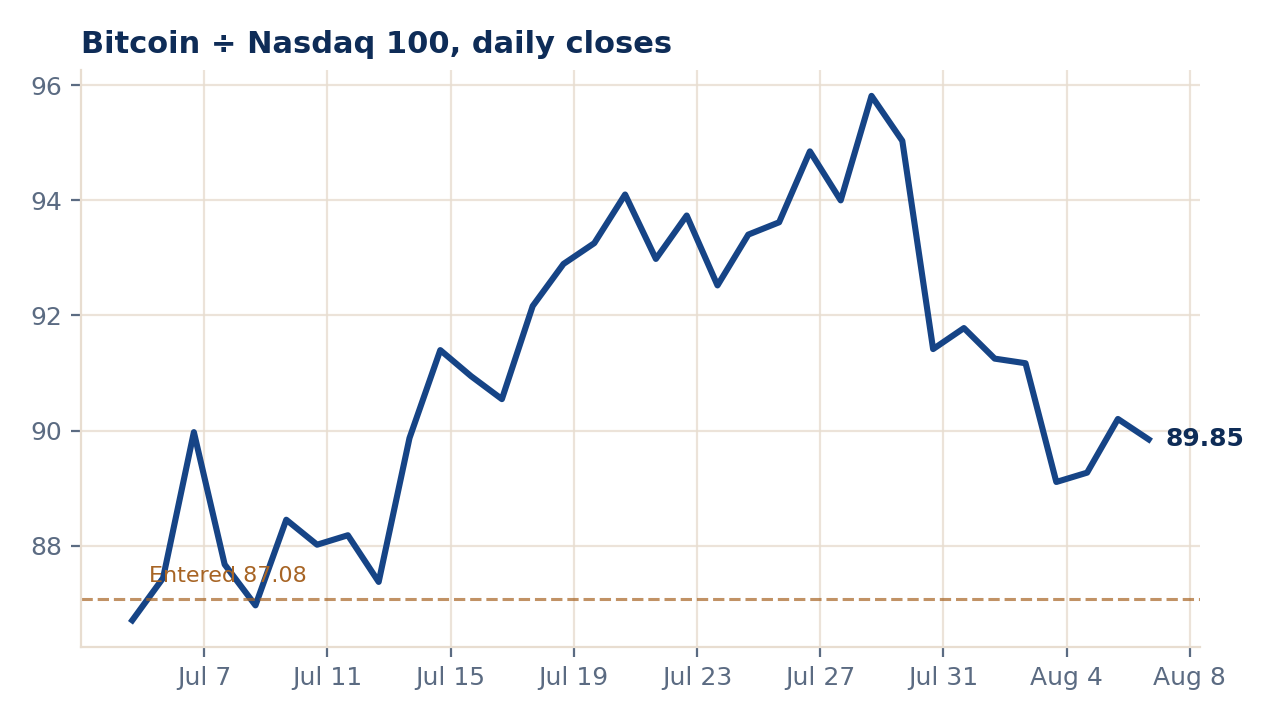
Bitcoin is still up on the week, but tech gained more, so the rotation spread moved the wrong way for a second time running. That is exactly the kind of move worth watching closely rather than reacting to.
Everything finished the week green except oil.
The sellers from last week disappeared, and buyers showed up instead.
A Bitcoin ETF lets investors, big and small, get exposure without holding it directly. Money flowing in means buyers are winning; flowing out means sellers are. Closer 8 flagged four straight outflow days. This week reversed completely, three straight inflow days, accelerating each day, and Ethereum’s fund saw the same. Buyers came back in force the same week two companies got punished for their earnings, a vote of confidence unrelated to that drama.
Friday decides whether this calm holds. Sometimes the right move is no move.
Nothing you own can be liquidated, so Friday is a question about conviction rather than survival. Bitcoin gained on the week while two tech names got punished on earnings, and ETF buyers came back after four straight days of selling last week. Both point the same way for a cash-owned position: this week gave you no reason to do anything.
Friday's jobs report lands after this goes out, and hike odds have already swung nineteen points in four days on softer hiring. A print in either direction can move rates expectations fast, the kind of move that can decide a leveraged position before you have a chance to react.
Staying flat into a scheduled number is itself a choice, and this is the week it pays off. You get to see the number before you commit any capital, an advantage nobody holding a position has. The work now is deciding what each outcome means to you, so when the number hits, you already know what to do with it.
Still alive, barely, and only if the Senate skips its own recess.
Sunday this looked like a likely miss with an outside chance of a save. Thursday it is down to procedure. Senate leadership passed on the step needed to force a floor vote, so passing inside the scheduled session is off the table. Lummis, who chairs the Senate digital assets panel, says the chamber will work into the weekend rather than leave without voting. Prediction markets are not buying it: 16% to be signed into law in 2026, down from 29% Sunday. Either the Senate skips its own recess, or this waits for a September calendar the midterm campaign is about to swallow.
A weak print extends this week’s calm. A strong one could revive the Fed scare that opened it. Either way, Opener 10 picks it up Sunday.
Report card: entered July 6 at BTC $62,500, selling the August $70,000 call for about $1,200. A month later the position is up roughly $2,659, because Bitcoin rallied and the call you sold got cheaper to buy back. Both halves worked. The roll trigger sits at $64,375 and Bitcoin closed just under it, so nothing is forced tonight, though the jobs number could clear that gap overnight. Rolling to the $72,000 call costs about $180 and buys $2,000 of extra room.
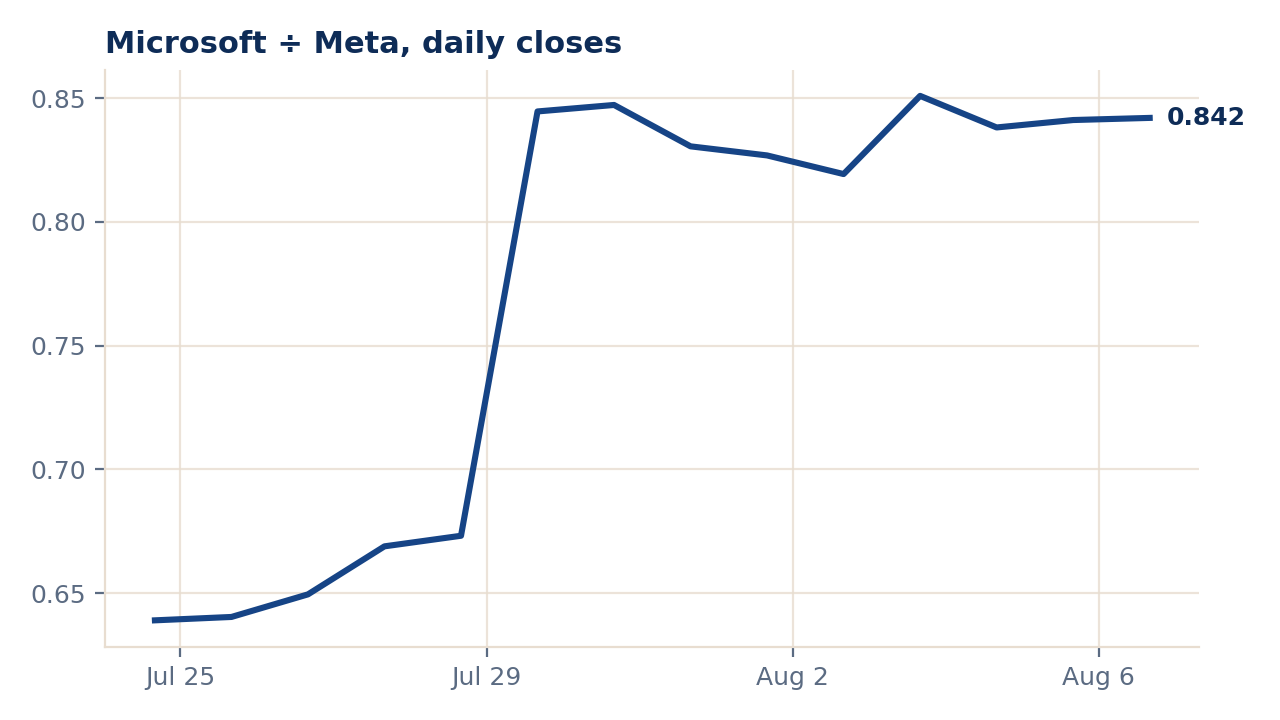
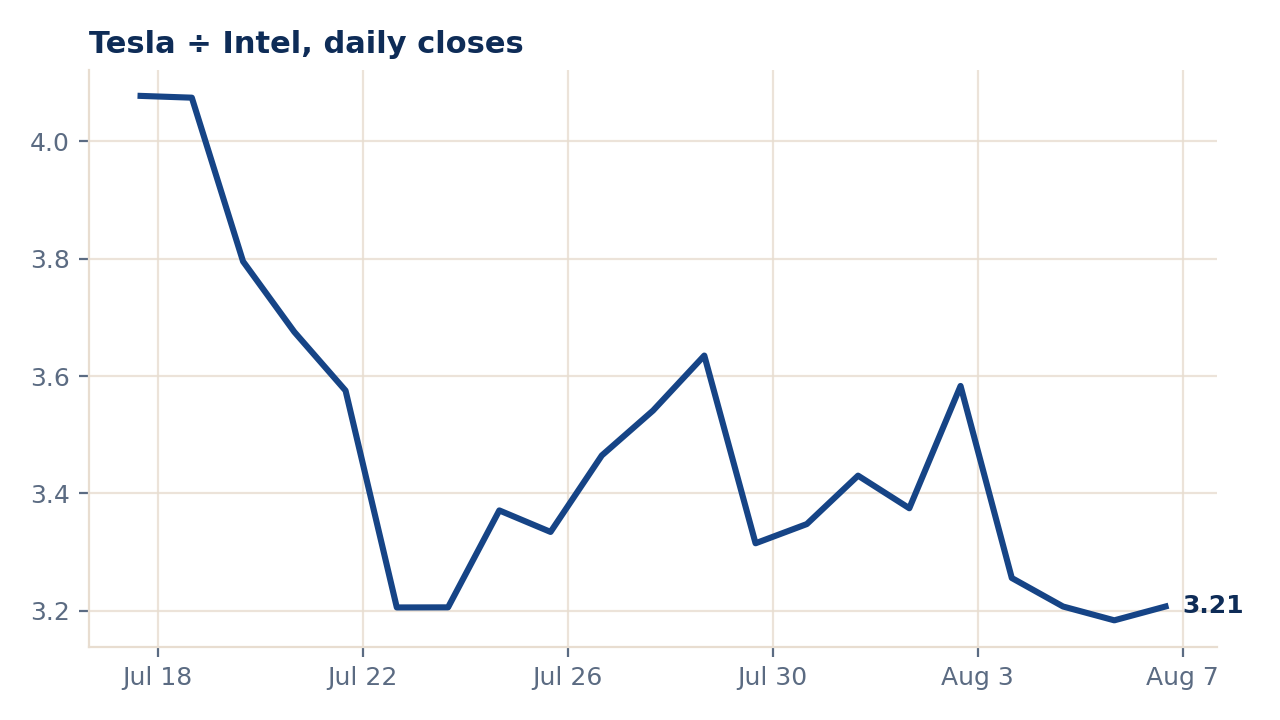
Read the Lesson →All three spreads above come from this lesson. None of them needed a call on direction, only on whether two things move apart or together, which is what makes a second straight pullback information rather than a loss.
Read the Lesson →This lesson covers raising cash against Bitcoin without selling your exposure, and there are two routes to do it. Sunday, one was clearly cheaper. This week the two costs converged, so the choice is close to a coin flip and the lesson’s comparison is the thing to run before you pick.
Read the Lesson →This content is produced by Harmonic for educational purposes. It is strategy education, not investment advice.