Core Curriculum · Module 3 of 8 · Derivatives Mastery
Options
How options work, and how to use them.
UnderstandApplyCase Study
An option gives you the right, but not the obligation, to buy or sell an asset at a fixed price by a specific date. If you buy that right, your maximum loss is the premium you paid, full stop: no liquidation, no margin call beyond it. Selling an option is a different position entirely. It requires posting margin, and an uncovered position can face the same liquidation risk as a futures trade, with theoretically unlimited loss on a naked call. This lesson covers both sides.
01
Understand
Calls, puts, and key terms.
Crypto options are almost always European style, meaning they can only be exercised at expiration, and cash settled. No actual crypto changes hands. The settlement is the difference between the strike price and the spot price at expiry.
Call option
Right to buy at the strike price. Profitable if price rises above strike plus premium paid. Bullish instrument.
Put option
Right to sell at the strike price. Profitable if price falls below strike minus premium paid. Bearish instrument or protection tool.
Strike price
The fixed price at which the option can be exercised.
Expiration
The date the option expires. Crypto options expire weekly, monthly, or quarterly.
Premium
The cost of the option. Influenced by time to expiration, implied volatility, and distance from the current price.
In-the-money (ITM)
The option has intrinsic value. For calls: spot is above strike. For puts: spot is below strike.
At-the-money (ATM)
Strike is approximately equal to the current spot price. Highest time value, delta near 0.5.
Out-of-the-money (OTM)
No intrinsic value. Cheaper, higher risk-to-reward. Most options expire here.
Implied volatility (IV)
The market’s expectation of future price movement, priced into the premium. High IV means expensive options. Crypto IV regularly runs 60 to 150 percent, far higher than equities.
02
Understand, continued
The Greeks: what moves your option’s price.
The Greeks describe how an option’s price changes in response to different market conditions. You do not need the math. You need to understand what each one means for your position.
Delta
Measures: How much the option price moves for a $1 move in the underlying. Ranges from 0 to 1 for calls, -1 to 0 for puts.
Means for you: An ATM call has a delta of roughly 0.5. It gains $0.50 for every $1 BTC rises.
Gamma
Measures: How fast delta changes as price moves. Highest at-the-money.
Means for you: High gamma means the option’s sensitivity accelerates as it goes in-the-money. Powerful, but fast-moving.
Theta
Measures: Time decay. The option loses value every day expiration approaches, all else equal.
Means for you: Theta hurts buyers and helps sellers. It accelerates as expiration nears.
Vega
Measures: Sensitivity to implied volatility.
Means for you: A high-vega option gains in value when IV spikes, common before major events in crypto. Selling options after an IV spike can be profitable even if price barely moves.
Long call vs. short call · who owns the unlimited side
Same contract, opposite sides. The buyer’s loss is capped at the premium; the seller’s loss on an uncovered call is not.
Long put vs. short put · who owns the unlimited side
Same logic in reverse. The put buyer’s loss is capped at the premium; the uncovered put seller is on the hook all the way down — loss is capped only because price cannot fall below zero.
The practical summary: theta kills long options over time. Vega makes crypto options expensive before events and cheap after. Know which one is working for or against you.
03
Understand, continued
Eight common strategies.
Buy call
Bullish. Maximum loss is the premium paid. Profit is unlimited above strike plus premium. Used to express an upside view with defined risk.
Buy put
Bearish or protective. Maximum loss is the premium paid. Profit increases as price falls below strike minus premium. Used to protect a long spot position.
Covered call
Hold spot, sell an OTM call. Collect the premium as income. Caps your upside at the strike price. Best in sideways or mildly bullish markets.
Protective put
Hold spot, buy a put as insurance. Limits downside loss to strike minus current price plus premium. Keeps unlimited upside intact.
Bull call spread
Buy a lower-strike call, sell a higher-strike call. Reduces the premium cost of a directional trade. Defines both maximum gain and maximum loss.
Bear put spread
Buy a higher-strike put, sell a lower-strike put. Cheaper downside protection than a naked put. Defines both maximum gain and maximum loss.
Iron condor
Sell an OTM call spread and an OTM put spread simultaneously. Collects premium in range-bound conditions. Profits if price stays between the two short strikes at expiration.
Straddle
Buy a call and a put at the same strike and expiration. Profits from a large move in either direction. Used ahead of major events. Vulnerable to IV crush post-event.
For long-term spot holders, the covered call is the most practical starting strategy. Sell a call 10 to 15 percent above the current price with two to four weeks to expiration. Collect the premium. If price stays below your strike, repeat. That premium compounds into meaningful yield over time. This position is covered by the spot you already hold, so the unlimited-loss risk in the diagram above does not apply here: the spot rising past your strike caps your upside, it does not create a liquidation event.
04
Understand, continued
Reading an options chain.
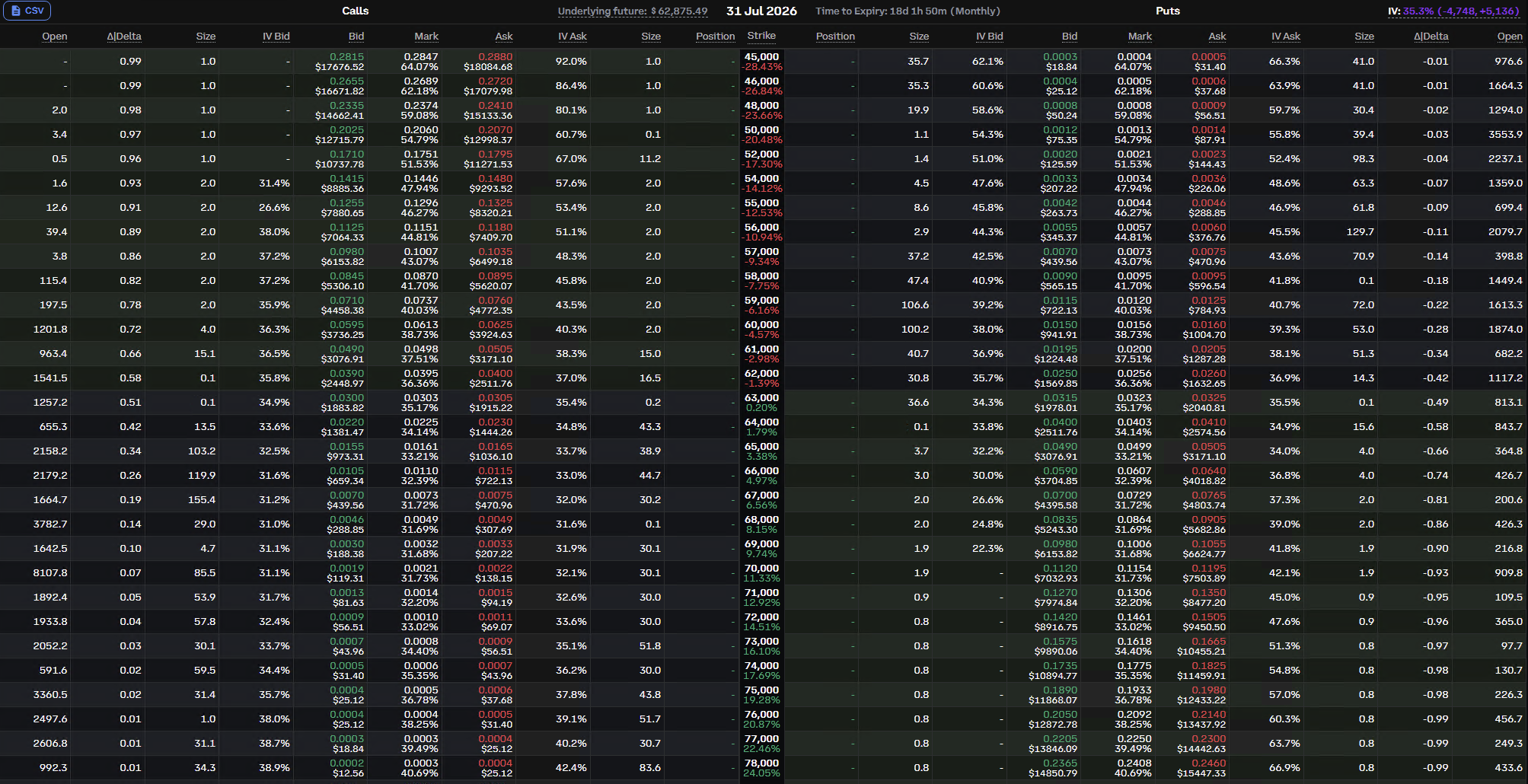
An options chain lists all available strikes for a given expiration. The columns you need: strike price, bid and ask (the cost to buy or sell the option), implied volatility, open interest, and delta. Look for strikes with reasonable bid-ask spreads and sufficient open interest — illiquid options have wide spreads that eat into returns before the trade even starts. The further out of the money, the cheaper and less liquid the option.
Scroll to see the full chain →
A live options chain for the 31 Jul 2026 BTC expiration, 18 days to expiry. The 63,000 strike (nearest to the $62,875.49 forward) shows a call mark of 0.0303 BTC and a put mark of 0.0323 BTC — deltas of 0.51 and -0.49, confirming it is the at-the-money strike, with 35.3% ATM volatility. Notice IV rises as strikes move further from the money in both directions: 35.4% at the 63,000 call versus 60.7% at the far out-of-the-money 50,000 call, the volatility smile in practice.
Terms used in this module
AssignmentWhat happens to an option seller when the buyer exercises. A short call gets assigned to sell at the strike; a short put gets assigned to buy at the strike.
Called awayWhen your spot is sold at the strike because the covered call you sold finished in the money. You keep the premium and the gain up to the strike, and no more.
CoveredA short option backed by a matching spot position (or an offsetting option). The spot you hold satisfies the obligation, so there is no liquidation risk.
Naked / uncoveredA short option with nothing backing it. If assigned, you must buy or sell the underlying at the market price, which is where the unlimited-loss risk comes from.
Cash-secured putA short put backed by cash set aside to buy the underlying if assigned, rather than backed by an offsetting position. Limits the seller’s risk to that reserved cash.
05
Apply
Two approaches, based on your position.
Choose one of the following approaches based on your current position. Do not try both at once.
If you hold spot BTC and want to generate yield
1
Identify the current BTC price and check the current implied volatility level. High IV means richer premiums for the call you are about to sell.
2
Select an expiration two to four weeks out. Choose a strike 10 to 15 percent above the current price.
3
Sell the call and collect the premium. Note the premium as an annualized yield on your spot position.
4
If BTC stays below your strike at expiration, keep the premium and repeat. If BTC closes above your strike, your spot gets called away at the strike; you still profited up to that level.
If you want defined-risk upside exposure without holding spot
1
Identify a strike price 5 to 10 percent above the current BTC price with an expiration four to eight weeks out.
2
Check the premium. Decide the maximum dollar amount you are willing to lose on this trade — that is your position size in premium terms.
3
Buy the call. Your maximum loss is the premium paid. Your maximum gain is uncapped above strike plus premium.
4
Monitor IV. If IV spikes significantly before expiration, the option may be worth selling early even if price has not moved much — the vega gain can be substantial.
06
Case study
April 2024: the BTC halving, IV expansion, and the crush.
2024 BTC HalvingApril 2024 · IV expansion then crush
In the months before the April 2024 BTC halving, implied volatility climbed steadily. The market anticipated a significant price move and priced that expectation into options premiums. Call buyers who entered early in the run-up captured both the directional price move and the vega expansion, a double gain.
After the halving, IV collapsed. This is called IV crush, and it is one of the most predictable patterns in crypto options. The event the market had been pricing uncertainty around had passed. Traders who held straddles found that even though BTC did move, the IV crush more than offset the directional gain. They were right on direction and lost money, because the premium they paid had assumed even higher IV than realized.
Covered call sellers on spot BTC had a different experience. Through the consolidation phases before and after the halving, they collected premium consistently. The total return on their spot position over that period outperformed pure holding, because of the premium income layered on top. This is the vega and theta framework from section 02 playing out in real prices: straddle buyers were long vega going into an event with a known resolution date, and paid for it when that vega collapsed. Covered call sellers were short theta the whole time, and time decay is exactly what they were being paid to accept.
IV crush is one of the most reliable patterns in crypto options. It occurs after any major known event: halvings, FOMC decisions, ETF approvals, major protocol upgrades. The market prices in uncertainty before. After the event resolves, that uncertainty premium evaporates. Long options lose it. Short options collect it.
07
Summary
Direction alone is not enough.
Key takeaway
Options give you defined maximum loss, income generation on spot holdings, and downside protection without selling. The two forces that determine whether a long option makes money are price direction and implied volatility. Being right on direction alone is not enough. Module 4 introduces prediction markets, which take the defined-risk structure of options and simplify it further: binary outcomes, no Greeks to manage, no liquidation, and a single number, the implied probability, as your entry signal.
Risk warning: options trading is extremely high risk. You can lose 100 percent of the premium paid on a long option rapidly. Selling naked options has unlimited loss potential — only sell options covered by a spot position or as part of a defined-risk spread. Most retail options traders lose money.
This content is produced by Harmonic for educational purposes. It is strategy education, not investment advice.
Get the full Harmonic week in your inbox.
Both issues, every week, delivered as clean PDFs you can read anywhere: