How to use a covered call to earn income on Bitcoin while you wait
Markets spend more time moving sideways or grinding slowly than they do making big directional moves. A covered call is built for exactly that environment. You already own the asset, or you want to. Instead of just waiting, you sell someone else the right to buy it from you at a higher price and collect cash today for that right. That cash is yours no matter what happens next. This lesson teaches you how to build the position, select the strike, manage it as the market moves, and roll it to keep the income stream running.
What a covered call actually is.
A covered call is one of the simplest options strategies there is. You own an asset. You sell someone else the right to buy it from you at a higher price before a set date. They pay you cash today for that right. That cash is yours to keep no matter what happens.
The word covered means you already own the asset — you are not selling a right to something you do not have. If the buyer exercises, it can only happen when Bitcoin is trading above your strike at expiry (no one pays $70,000 for Bitcoin they can buy cheaper in the open market). So the only scenario where they exercise is one where Bitcoin has already moved up past your strike — meaning you have already made money on the rally. If they exercise, you simply deliver your Bitcoin at the agreed price from your existing holdings. That is the whole structure.
Two types of people use this strategy in different ways — both are valid.
You hold Bitcoin and want to earn additional income on it while you wait for the market to confirm direction. You sell a call at a strike above where Bitcoin trades today and collect the premium immediately. If Bitcoin stays below that strike through expiry you keep your Bitcoin and the premium. If Bitcoin rallies through the strike you participate in the move up to that level and also keep the premium. Either way you collected income on a position you were already holding.
You want exposure but are cautious about the current environment. You buy Bitcoin at the current price and immediately sell a call against it. The premium reduces your effective cost basis from day one. If Bitcoin stays flat or moves sideways you earn income while you wait. If Bitcoin moves up through the strike you still participated in the rally to that level. Your entry is effectively cheaper than someone who just bought without selling the call.
The four decisions you make before every covered call.
A covered call has four variables. Every time you put one on you are making four decisions. Here is the framework for each, based on what works in practice for Bitcoin specifically.
The strike is the price at which you agree to sell your Bitcoin if the buyer exercises. You want it far enough above current price to participate in a meaningful rally before getting called away, but close enough that the premium is worth collecting. At $62,500 that puts your target between $68,750 and $71,875 — the $70,000 strike is the natural anchor at the midpoint. Lower strikes collect more premium but cap upside sooner; higher strikes collect less but give more room to run.
Options lose value faster the closer they get to expiry — think of a melting ice cube. A 60-day option melts slowly; a 7-day option melts fast. Selling a 30–60 day call puts you in the sweet spot where the option is still worth enough to collect meaningful income but the clock works in your favor. Long enough to collect real premium, short enough that if the market changes you are not locked in for months. Monthly expiries, usually the last Friday of the month, are the most liquid and easiest to roll.
One call contract covers one Bitcoin on most crypto options platforms. If you hold one Bitcoin, sell one call. If you hold 0.5 Bitcoin you cannot sell a full contract without taking on more risk than intended — a different, riskier strategy entirely. Start with one call per Bitcoin. The rule is simple: the calls you sold must always be fully covered by the Bitcoin you hold. That is what makes it a covered call and not something else.
Rolling means closing the call you sold and opening a new one at a higher strike or later expiry. You roll up when Bitcoin rallies 3–5% toward your strike, to give yourself more room and collect fresh premium at the new level. You roll at expiry when the call expires worthless — collect the full premium and sell a new call for the next period. If Bitcoin is approaching your strike and you want to keep it, roll before expiry. If you are comfortable selling at the strike and taking the profit, let it run. That decision is yours.
A covered call does not protect you if Bitcoin falls significantly. The premium softens the loss but does not eliminate it — if Bitcoin drops 20%, you lose 20% on your position minus whatever premium you collected. It is an income strategy, not a hedge. If your primary concern is a large downside move, a covered call alone is not the right tool. This is designed for a market with uncertain direction, not one you expect to fall sharply. If your view changes and you expect a large downside move, close the position and revisit.
Five questions to answer before selling a call.
Before you sell any covered call, answer these five in order. If you cannot answer all five clearly, do not put the trade on yet.
A covered call works best when you expect Bitcoin to move sideways to modestly higher over the next 30–60 days. If you expect a large rally you may want to just hold and not cap your upside. If you expect a large drop you may want to reduce your position first. The covered call is for the uncertain, stabilized environment where you want to earn income while you wait for confirmation.
If your view suggests Bitcoin could rally 10–15% from current levels, a strike at that level gives you full participation in that move. If you think it could run 20% or more, you might want a higher strike to avoid capping upside too soon. Be honest about your view before picking the strike — the strike tells the market, and yourself, where you think upside is capped for now.
Look at the mark price for the call. At the $70,000 strike with ~54 days to the August 28 expiry, the market is showing ~$1,200 per Bitcoin — about 1.9% of the current price for 54 days, roughly 13% annualized. Meaningful income on a position you already planned to hold. Rule of thumb: if the premium does not cover at least 1% of your Bitcoin price for a 30-day equivalent, the trade is not worth the complexity. The July 31 expiry pays only ~$387 for the same strike, which is why the August expiry is the better choice here.
Decide before you put the trade on. Look at what is scheduled between now and expiry — inflation prints, central-bank meetings, large-bank earnings, geopolitical developments can all move Bitcoin sharply. If a significant event falls inside your window, ask: am I comfortable holding through it, and if it goes against my thesis, what do I do? A hot inflation report and climbing rate-increase odds may be the signal to close rather than roll. Know your calendar and your exit conditions before you enter.
Count your Bitcoin. Count your calls. One call covers one Bitcoin. If you sell two calls you need two Bitcoin. There is no exception to this rule for a covered call. If you ever have more calls outstanding than Bitcoin held, you have crossed into an uncovered position where your potential loss is unlimited. Do not let that happen by accident.
The live setup. July 6, 2026. BTC at $62,500.
This is the actual setup from the current Bitcoin options market as of this week. The prices below are sourced from live market data — round numbers for clarity, but they reflect the real market.
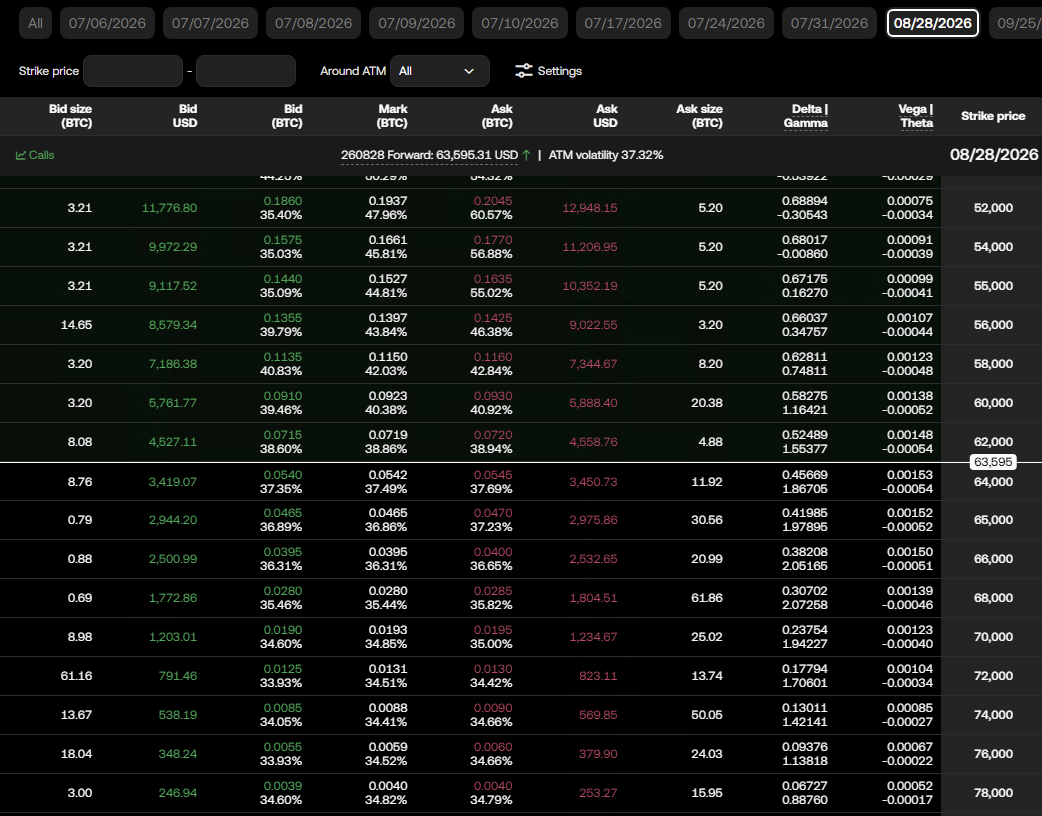
Now let us walk through the three possible outcomes at expiry on August 28.
Bitcoin ends August anywhere below $70,000, say at $65,000. The call you sold simply expires and disappears — nobody pays $70,000 for something they can buy at $65,000. You keep your Bitcoin at its current market value and the full $1,200 premium. Your total return for the 54 days is $1,200 plus the $2,500 Bitcoin moved from $62,500 to $65,000 — $3,700 on one Bitcoin. Now sell the next call for September and repeat.
Bitcoin ends August at $70,000. Your gain is $7,500 on the move from $62,500 plus the $1,200 premium — $8,700 total on one Bitcoin for 54 days. This is the best possible covered-call outcome: you captured the full move you expected and collected income on top. One practical note: if Bitcoin is trading at or above your strike as expiry approaches, the cleanest move is to close the position before expiration — buy back the call and take your gain. That avoids any assignment uncertainty and keeps you in control.
Bitcoin is at $78,000 heading into August 28. This is exactly where you roll before expiry rather than wait. As soon as Bitcoin rallies 3–5% toward your $70,000 strike, the rolling rules kick in: buy back the $70,000 call and sell a new one at a higher strike, say $75,000 or $80,000, for the next expiry. You collect fresh premium and stay long with a new ceiling. If you do nothing and let it run to expiry above $70,000, you are assigned: the buyer takes your Bitcoin at $70,000, you receive $70,000 plus the $1,200 premium ($8,700 total), but with Bitcoin at $78,000 you missed $8,000 of upside. The lesson is to roll early when Bitcoin moves toward your strike — not to wait and hope it reverses.
When and how to roll your call.
Rolling is the active-management part of the strategy. You do not just put the trade on and forget it. Here are the two situations where you roll, and exactly what to do in each.
Say you sold the $70,000 call when Bitcoin was at $62,500, and it rallies to $65,500 — roughly 5%. Your call is now worth more because Bitcoin is closer to the strike. If you want to stay in and keep participating, buy back the $70,000 call (now maybe $1,500, up from $1,200) and simultaneously sell a new call at a higher strike, say $73,000, for the same or later expiry. The $73,000 call might pay $1,000, so your net cost to roll is $500 — but your new strike is $3,000 higher, giving you more room if Bitcoin keeps rallying. Rolling up every 3–5% keeps the yield engine running at progressively higher levels. If instead you feel Bitcoin has reached your target, let it run to expiry and take the gain. That is valid too — what you do at the strike is yours to decide.
Bitcoin never reached your strike. The call expires at zero and you kept the full premium. Now immediately sell the next month’s call at the same or a similar strike — do not wait. The premium income compounds when you stay consistent. If Bitcoin is still at $65,000, sell a call 10–15% above wherever it is trading now. Rinse and repeat every 30–60 days.
The framework in one place.
BlackRock launched its yield-generating Bitcoin ETF in June 2026, targeting 15–25% annual yield through a monthly options-writing program. Goldman Sachs filed for a similar product. Wall Street packaged this strategy, gave it a ticker, and charges a fee for it. What you just learned is how to do the same thing yourself on any crypto options platform that offers Bitcoin options. No wrapper. No fee. Just the strategy.
The covered call is not a prediction. It is a position. You are not saying Bitcoin will or will not go up — you are saying that whatever happens, you want to earn income on the Bitcoin you hold or buy while the picture confirms. The premium you collect changes your economics regardless of direction. That is the edge.
It works in any environment where you want to hold an asset and earn income while you wait for direction to confirm. Sideways market, slow grind, uncertain macro backdrop — any of those is the right setup.
This content is produced by Harmonic for educational purposes. It is strategy education, not investment advice. Options involve risk and are not suitable for all investors.
Both issues, every week — delivered as clean PDFs you can read anywhere: