Home / Learn / Macro and the Fed
How the Fed, Interest Rates, Inflation and the Dollar Affect Crypto
Education only. Not financial advice. Trading derivatives carries a high risk of loss.
Short answer
Events like an oil spike push inflation up, inflation changes what the Fed does with interest rates, and higher rates make cash and bonds pay more. Assets that pay nothing, like Bitcoin, then have to compete, so capital tends to move toward safety. A stronger dollar and ETF outflows usually add pressure, and the reverse eases it.
How does the Fed affect crypto? Through a chain. The Fed reads economic data, sets the price of money through interest rates, and every asset reprices against that. Harmonic’s macro framework teaches you to spot which link in the chain is moving and trace it forward before the headlines catch up. This guide walks through each link and shows it with real examples from the weekly briefs.
- The macro chain
- How the Fed affects crypto
- How interest rates affect Bitcoin
- How inflation affects crypto
- How the dollar affects Bitcoin
- How ETF flows affect Bitcoin
- What to watch each week
- What macro cannot tell you
- FAQ
The macro chain
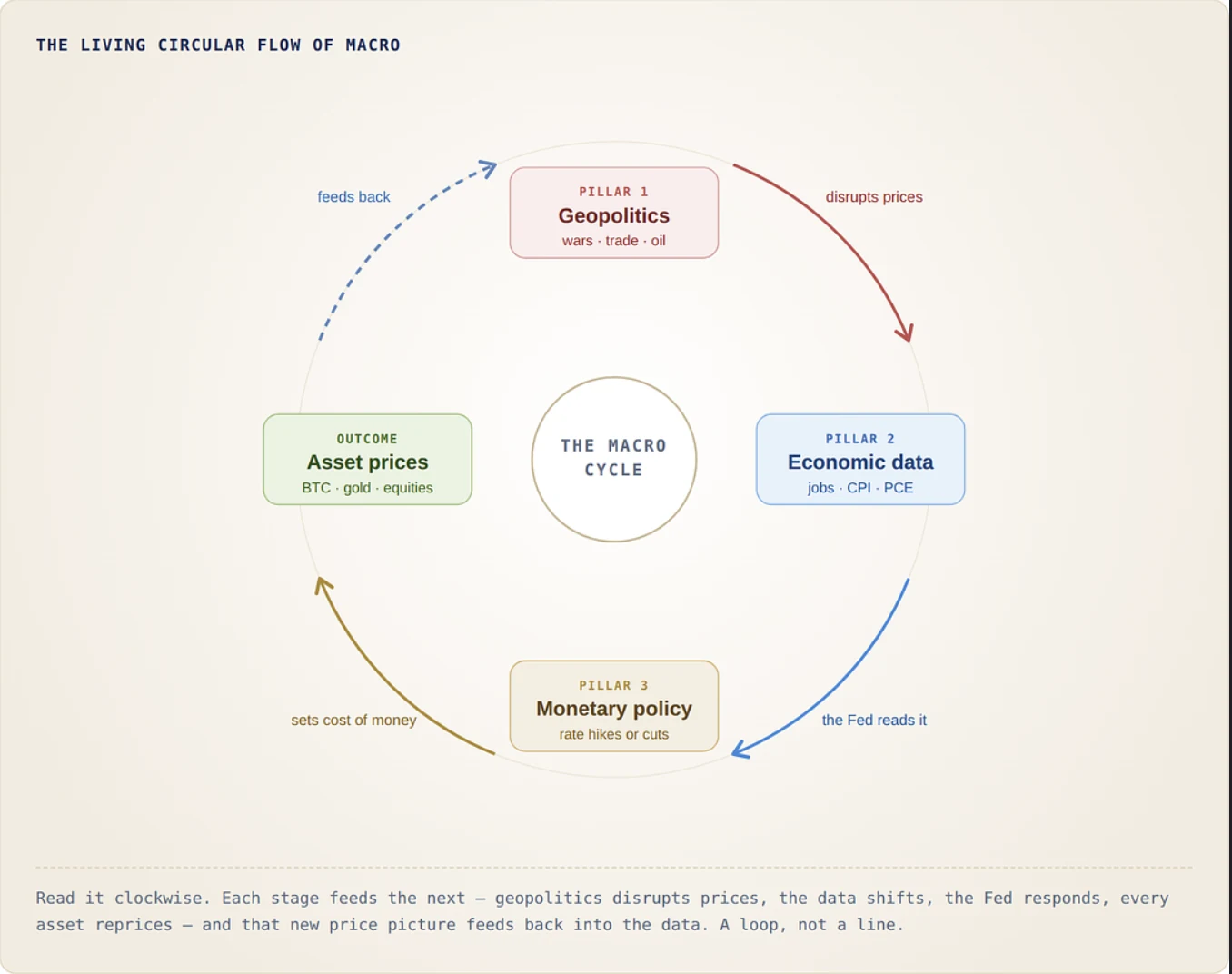
Every major move in Bitcoin, gold, oil and equities traces back to one or more of three things: economic data that shows how the economy is running, central banks responding by setting the price of money, and geopolitical events that disrupt the inputs before the data is even measured. Read them as a loop. Geopolitics disrupts prices, the data shifts, the Fed responds, every asset reprices, and the new prices feed back into the data.
Example from Harmonic’s Lesson 4
The lesson traces the loop through a real episode in 2026, from the Strait of Hormuz to Bitcoin.
| Link in the chain | What happened |
|---|---|
| Geopolitics | The US and Israel struck Iran on February 28. Iran closed the Strait of Hormuz, which carries about 20% of the world’s oil |
| Oil | WTI was near $72 when the conflict started and spiked to a $113 close on April 7, a rise of about 57% |
| Inflation | May CPI came in at 4.2% annual, with nearly all of the overshoot above core in energy |
| Central banks | The ECB raised for the first time since 2023 on June 11, citing the war. The Fed held but dropped any language suggesting cuts |
| Crypto | Bitcoin fell from above $73,000 in late May to below $60,000 by early June |
The framework said to watch the Strait as the primary inflation input and trace it forward, which was answerable before any central bank meeting or inflation report. The lesson also gives five questions to ask before any data release or central bank decision: which commodity does this touch, what does it do to inflation, what does that mean for the Fed, where does the capital come from, and under what conditions does the thesis break.
Here’s the current state, plus three ways this week could evolve from here.
Hike odds barely moved. Our read: a strong factory reading and falling oil roughly offset each other. On Hyperliquid, a crypto exchange where positions are public, traders opened new bets that oil and stocks would keep falling. Section 05 has the detail.
This path needs three things: earners that reassure, a jobs number that is firm without being hot, and no strike headlines after the vote. Then the selloff could settle and the Fed story would stay quiet. If the earners disappoint or the jobs report runs hot, the selloff could resume.
This is the path where the vote keeps the AI selloff going. A split Congress or a Republican surprise would do the opposite, and the Senate count may take days to settle.
This path does not depend on earnings or the jobs report. Talks that hold would do the opposite, easing oil and rates, so the headlines can cut either way. Our read: oil is the swing, because strikes plus a hot jobs report would hit AI stocks from two sides.
How the Fed affects crypto
The Fed reads the economic data and decides what to do with interest rates. For crypto traders, the decision matters less than the odds of the decision. Markets move when the probability of a hike or a cut changes, often well before the meeting. Those odds are read from the market itself. CME FedWatch is a tool from CME Group, built on CME products. It takes federal funds futures prices and turns them into probabilities of where the Fed’s rate will be in the future, tied to the exact dates of each FOMC meeting.
Examples from Harmonic’s weekly briefs
- July 23, 2026 Closer. After Houthi attacks on two Saudi oil tankers opened a second shipping chokepoint and Brent crossed $100, September rate-increase odds jumped from 61.4% to 81.4% in four days.
- September 25, 2026 Closer. Fed speakers and a hot business survey pushed October hike odds up from 55.4% on Monday to 64.2% by the end of the week, and Bitcoin ended the week lower.
How interest rates affect Bitcoin
How do interest rates affect Bitcoin? Through the cost of capital and risk appetite. When rates rise, cash and bonds pay real returns, and every asset that pays nothing, such as Bitcoin and gold, has to compete with that. Higher rates push capital toward safety. Lower rates push it toward risk. When rates stay high, zero-yield assets become less attractive. Harmonic’s Lesson 4 calls this the direct mechanism connecting macro events to crypto prices. The reverse is rate relief: when rate expectations fall, because the central bank cuts or because the data lowers the odds of future hikes, it lowers the opportunity cost of holding non-yielding assets and tends to benefit risk assets like Bitcoin.
How inflation affects crypto
How does inflation affect crypto? Mostly through the Fed. Higher inflation gives the Fed a reason to keep rates high or raise them, and lower inflation gives it room to ease. Three readings matter most:
- CPI, the Consumer Price Index, the US government’s main monthly report on inflation. It measures how much prices have risen across a broad basket of everyday goods and services.
- PCE, the Personal Consumption Expenditures price index, the Federal Reserve’s preferred inflation measure. It tracks what American consumers actually spend on goods and services. Core PCE strips out food and energy to show underlying inflation, because those prices are volatile.
- PPI, the Producer Price Index, a measure of inflation at the wholesale level, tracking prices before they reach consumers. It is released the day after CPI and either confirms or contradicts the consumer inflation picture.
The size and persistence of the move matter. A one-week oil spike differs from a sustained disruption. In the June 27 Closer, PCE came in at 4.1% for May, up from 3.8% in April, with core PCE at 3.4%. The numbers matched expectations, which meant no upside surprise but also no relief, and PCE gave the Fed no reason to soften its stance. In Lesson 4, May CPI at 4.2% came mostly from energy.
How the dollar affects Bitcoin
How does the dollar affect Bitcoin? The Dollar Index, often called DXY, measures the dollar’s strength against a basket of six major currencies. A rising DXY generally puts pressure on dollar-priced assets like Bitcoin and gold. Rising odds of a Fed hike tend to strengthen the dollar and pressure those assets, so the two often move together, and Harmonic’s Lesson 6 lists rising hike odds as a reason to size down or hedge.
How ETF flows affect Bitcoin
How do ETF flows affect Bitcoin? A Bitcoin ETF is a fund that holds actual Bitcoin and issues shares that investors can buy through a regular brokerage account. When money flows into the fund, that usually means institutions are buying. When investors sell their shares, the fund has to sell Bitcoin to pay them back, which directly affects the real Bitcoin market. Tracking flows separately from price shows whether a move came from real buying and selling pressure.
The funds buy the real thing. When an ETF sees large inflows, its authorized participants have to buy spot Bitcoin to back the new shares. That is spot demand with no perpetual leg attached. It pushes the spot price up directly, and it does not raise funding in the perpetual market, which can produce a rally with suppressed funding. The reverse holds for outflows.
Example from Harmonic’s weekly briefs
- September 25 Closer. Bitcoin ETFs saw inflows every day that week, more than $2.38 billion net, and yet Bitcoin ended the week lower. The flows and the price told two different stories.
What to watch each week
Run the five questions from Lesson 4 before each release. These are the releases that tend to matter most, and the briefs track them:
| Release | What it tells you |
|---|---|
| FOMC decisions and minutes | The committee that sets interest rate policy meets roughly eight times a year. The press conference after the decision is often more market-moving than the decision itself |
| CPI, PCE and PPI | Whether inflation is cooling or heating, which shapes the Fed’s next move |
| Jobs report (nonfarm payrolls) | A monthly report of jobs added or lost. A strong number reduces the likelihood of rate cuts, which tends to be negative for Bitcoin in the short term |
| GDP | The broadest measure of economic output. A miss can weaken a currency and dampen risk appetite |
| ISM manufacturing and services PMIs | Surveys of purchasing managers. A reading above 50 means the sector is expanding, and below 50 means it is contracting |
| Consumer confidence and sentiment | How optimistic consumers feel. A sharp drop suggests households may pull back on spending |
| Treasury yields and auctions | Yields are the rates Treasuries are trading at, and rising yields make bonds more attractive relative to risk assets. Auctions are when the Treasury issues new ones, on a set schedule |
| Daily ETF flows and the dollar index | Whether institutions are buying, and how the dollar is trading |
Harmonic’s Weekly Brief covers this calendar every Monday and Friday. Our Weekly Market Brief page shows what each issue includes.
What macro cannot tell you
Correlation is not constant. A relationship that holds for months can break. Harmonic’s Module 8 notes that gold and crypto’s relationship to real yields has held in some periods and decoupled in others. It treats these looser links as a clue to watch, never as a lever to lean your full weight on.
- The majors and the rest. In the September 25 Closer, Bitcoin and Ethereum fell while Solana and XRP rose by double digits the same week, so the macro pressure landed unevenly.
- The exact trigger. Getting the general shape of a scenario right, such as policy tightening, hike odds rising and the dollar firming, does not require naming the exact headline that will do it. The briefs score their own calls for that reason.
Frequently asked questions
How does the Fed affect crypto?
The Fed sets short-term interest rates in response to inflation and economic data. When it raises rates or signals that it will, cash and bonds pay more, and assets that pay nothing, such as Bitcoin, become less attractive. When it eases, capital tends to move toward risk. Markets often react to the odds of a decision before the decision itself.
How do interest rates affect Bitcoin?
Higher rates raise the return on cash and bonds, so every asset that pays nothing has to compete with that. Higher rates push capital toward safety, and lower rates push it toward risk. Rates also change the cost of borrowing, which affects how much leverage the market carries.
How does inflation affect crypto?
Inflation matters because of what the Fed does about it. Higher inflation gives the Fed a reason to keep rates high or raise them, which makes zero-yield assets less attractive. Lower inflation gives it room to ease. The readings that matter most are CPI, PCE and the Producer Price Index.
How does the dollar affect Bitcoin?
The Dollar Index, or DXY, measures the dollar’s strength against a basket of six major currencies. A rising DXY generally puts pressure on dollar-priced assets like Bitcoin and gold. Rising odds of a Fed hike tend to strengthen the dollar, and the two often move together.
What is a Bitcoin ETF and how do flows affect price?
A Bitcoin ETF is a fund that holds actual Bitcoin and issues shares that investors buy through a regular brokerage account. When money flows into the fund, that usually means institutions are buying, and when investors sell their shares, the fund has to sell Bitcoin to pay them back. Tracking flows separately from price shows whether a move came from real buying or selling pressure.
Which economic data releases matter most for crypto?
The ones that change what the Fed is likely to do next. That means inflation readings such as CPI, PCE and PPI, jobs reports, GDP, purchasing-manager surveys, and the Fed’s own decisions and minutes. Daily ETF flows and the dollar index add context.
Go deeper in Harmonic Academy. The community has the weekly briefs, and the core curriculum, the lessons and the live lesson tools are there too.
Join Harmonic AcademyRelated guides
Education only. Not financial advice. Trading derivatives carries a high risk of loss. Macro conditions describe pressure on prices, not a prediction or a promise of any result.