Home / Learn / Margin, Liquidation & Risk Management
How to Avoid Liquidation in Crypto: Margin, Leverage and Risk Management
Education only. Not financial advice. Trading derivatives carries a high risk of loss.
Short answer
You avoid liquidation by keeping the price that would liquidate you far from your entry, and by exiting on your own terms before the exchange does it for you. Good crypto trading risk management starts there. These five controls reduce the chance of liquidation. They do not remove it.
- Know your liquidation price before you enter the trade, and reduce your leverage if it sits too close to the current price.
- Use isolated margin so a single position cannot draw on your whole account.
- Keep leverage low. Around 3 to 5x leaves a real buffer, and above 10x a single volatile candle can end the trade.
- Size the position from your stop, and risk no more than 1 to 2% of your account on any one trade.
- Place your stop-loss well before your liquidation price, and do not add margin to a losing position.
This guide is the risk hub for the Learn section. Every other guide links here.
- What is margin in crypto trading?
- Isolated vs cross margin
- What is liquidation?
- Liquidation price calculator
- How much leverage should I use?
- Position sizing
- Stop losses and other risk controls
- Common mistakes
- FAQ
- Risk disclosure
What is margin in crypto trading?
Margin is the collateral you post to open and hold a leveraged position. Leverage multiplies your position size relative to that margin. At 5x, $2,000 of margin controls a $10,000 position. A 10% move against you produces a $1,000 loss, which is 50% of your margin. At 10x, the same 10% move wipes the margin out entirely.
There are two margin numbers to know. They are the margin requirements in crypto derivatives explained in two figures, and the gap between them decides when you get liquidated.
| Initial margin | Maintenance margin | |
|---|---|---|
| What it is | The margin you post to open the position | The minimum margin balance you must keep for the position to stay open |
| How it is set | Position size ÷ leverage | A percentage of the position’s value, set by the exchange. It varies by exchange |
| What happens at this level | You can open the trade | Liquidation triggers automatically once your balance falls to this level |
Example from Harmonic’s Module 2, with an assumed 0.5% maintenance margin
You open a $10,000 position at 5x leverage. Your initial margin is $10,000 ÷ 5 = $2,000.
Assume the exchange’s maintenance margin rate is 0.5%. That is $10,000 × 0.005 = $50.
The position is liquidated when losses have pulled your margin balance from $2,000 down to about $50. That is a loss of about $1,950, or a 19.5% move against a long position.
Your margin can also be denominated in different ways. With a USD-settled contract, margin and profit and loss are in dollars, so a $1,000 price move produces a predictable dollar result. With a coin-margined contract, they are in the underlying crypto, and the dollar value of your margin changes with price. USD-settled is simpler and a better place to start.
Isolated vs cross margin
Margin mode decides how much of your account a single position can draw on.
| Isolated margin | Cross margin | |
|---|---|---|
| Margin used | Only the margin you allocate to that one position | Your whole account balance, shared across all open positions |
| What one bad trade can cost | The margin allocated to that position | Potentially your full account |
| Capital efficiency | Lower, because margin is walled off | Higher, because positions share one pool |
| Typically used for | Directional trades and first trades | Experienced traders managing several positions together |
For your first trades, use a USD-settled contract with isolated margin. That combination gives you predictable dollar profit and loss and caps your loss at what you put into that one position. Coin-margined contracts and cross margin both add complexity that is worth learning once you have some experience.
What is liquidation, and what is a liquidation price?
Crypto futures liquidation explained simply: it is the exchange forcibly closing your position because your margin balance has fallen to the maintenance margin level. You lose the margin in that position, and you lose control of the exit. The liquidation price is the price at which that happens. It depends on your leverage, not only on your direction, and you can work it out before you enter, so you never have to discover it afterward.
For an isolated margin position, the approximate formulas are:
- Long: liquidation price = entry × (1 − 1 ÷ leverage + maintenance margin rate)
- Short: liquidation price = entry × (1 + 1 ÷ leverage − maintenance margin rate)
Harmonic’s Module 9 formula applied to the $77,000 Bitcoin price used in Lesson 8
You buy Bitcoin at $77,000 with 5x leverage, and the maintenance margin rate is 0.5%.
- Long: $77,000 × (1 − 0.20 + 0.005) = $77,000 × 0.805 = $61,985, which is 19.5% below your entry.
- Short: $77,000 × (1 + 0.20 − 0.005) = $77,000 × 1.195 = $92,015, which is 19.5% above your entry.
Liquidations can also feed on themselves. Each forced sale pushes the price lower, which triggers the next wave of liquidations. Between May 12 and May 19, 2021, over $10 billion in leveraged positions were liquidated across exchanges as Bitcoin fell from about $58,000 to below $30,000. Funding rates had been above 0.05% per 8-hour period for weeks beforehand, a sign of how crowded the leverage was. Your own liquidation price is only part of the risk. How much leverage everyone else is carrying matters too.
Liquidation price calculator
A liquidation price calculator turns a few inputs into the price at which your position would be closed. This page shows the calculation worked by hand, using the formulas above. The figures are illustrative, not live prices.
The inputs
- Direction. A long profits when the price rises, and a short profits when it falls. The liquidation price sits below your entry for a long and above it for a short.
- Entry price. The price at which you open the position.
- Leverage. The position size divided by your margin. Higher leverage puts the liquidation price closer to your entry.
- Maintenance margin rate. The exchange’s minimum margin, as a percentage of the position. It varies by exchange, so use the figure the exchange publishes for your contract.
- Margin mode. These formulas assume isolated margin. Under cross margin, the real trigger depends on everything else in your account.
| Direction | Entry | Leverage | Maintenance margin rate | Liquidation price | Move against you |
|---|---|---|---|---|---|
| Long | $77,000 | 5x | 0.5% | $61,985 | 19.5% down |
| Short | $77,000 | 5x | 0.5% | $92,015 | 19.5% up |
| Long | $77,000 | 10x | 0.5% | $69,685 | 9.5% down |
How to read it
Know your liquidation price before you place the order. If it is too close to the current price, reduce your leverage or wait for a better entry. Do not rely on the exchange to warn you in real time.
The Borrow dashboard in Harmonic Academy
Harmonic Academy has a Borrow dashboard that works out a real liquidation price for a specific structure. You sell some of your spot holding for cash, use part of that cash as margin on a long position, and stay in the trade without selling everything. The dashboard shows:
- The loan-to-value you choose, which sets how much spot you sell and how much you keep.
- The exact spot to sell and the spot to keep, in the asset’s own units, not just dollar amounts.
- A real liquidation price for each exchange it covers: Deribit, OKX and Crypto.com.
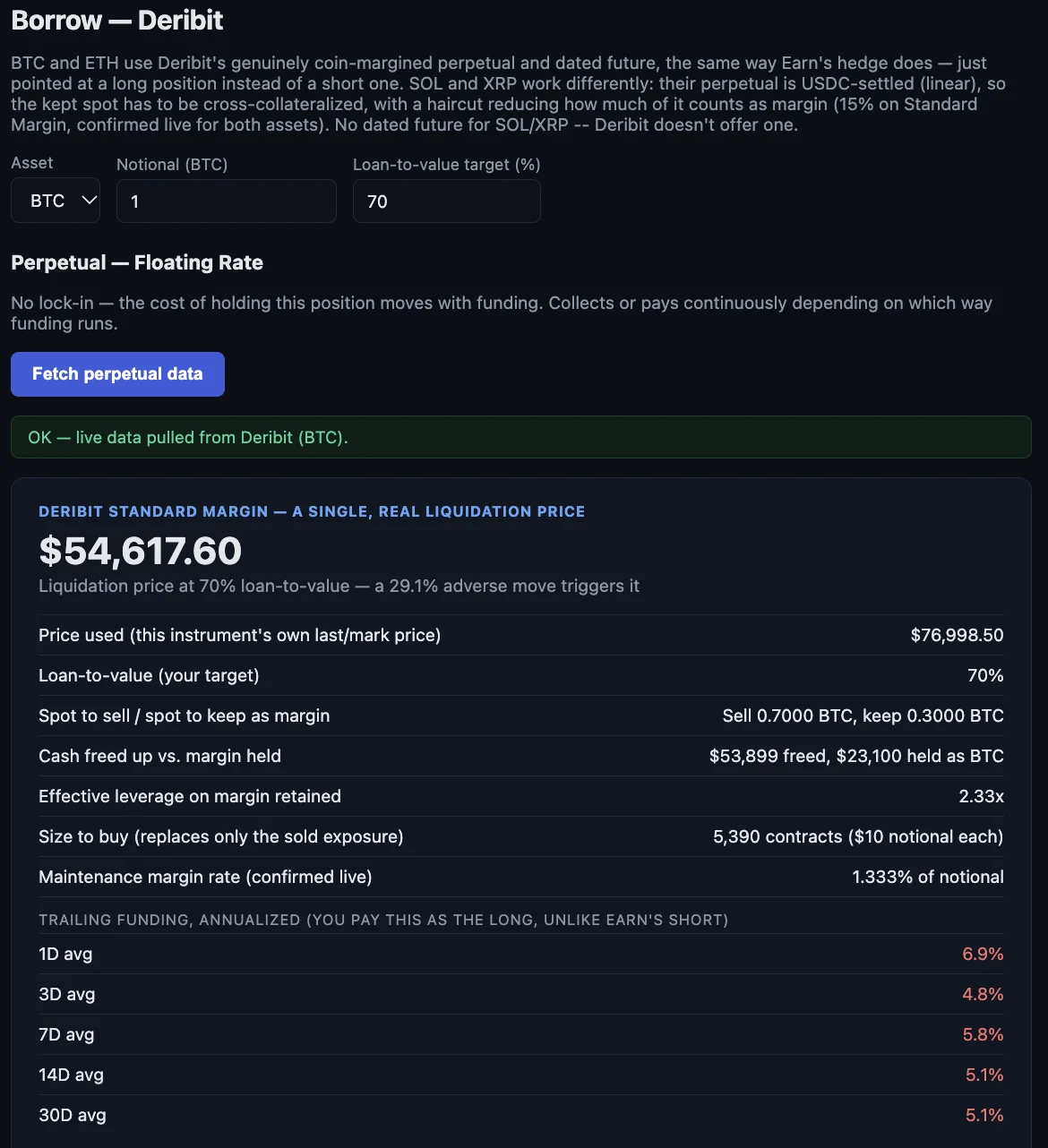
In this capture, the liquidation price is $54,617.60, a 29.1% adverse move from the $76,998.50 price used.
The lessons, the live lesson tools and the core curriculum are part of Harmonic Academy, along with the weekly briefs.
How much leverage should I use?
There is no single right answer, and this is education, not advice. A common rule of thumb is 3 to 5x, which leaves a buffer to manage a position actively. Above 10x, a single volatile candle can trigger liquidation before you can react. The table below works as a crypto leverage risk management guide, because it shows how leverage changes the distance to liquidation for a long position.
| Leverage | Approximate move against you to reach liquidation | Illustrative liquidation price, long at $77,000 | What it means |
|---|---|---|---|
| 3x | About 33% | $51,718 | A real buffer to manage the trade |
| 5x | About 20% | $61,985 | Manageable, with a tighter margin for error |
| 10x | About 10% | $69,685 | A routine daily swing can end the position |
| 20x | About 5% | $73,535 | A small adverse move can end the position |
The liquidation prices in the table assume a 0.5% maintenance margin rate. The percentages ignore that rate, which is why they are shown as approximate.
Leverage is not the only cost of holding a position. On perpetual futures you also pay or receive funding, and a high funding rate can cost more than you expect over time. Our guide to perpetual futures and funding rates explains how to read it.
Position sizing
Crypto position sizing decides whether a correct view turns into a profit or into a damaged account. Losses are also harder to recover from than they look. A loss of 10% needs a gain of 11% to get back to even. A loss of 25% needs 33%, and a loss of 50% needs 100%. Avoiding large losses matters more than capturing large gains.
A simple starting point is to risk no more than 1 to 2% of your account equity on any single position. Then size from your stop, not from your leverage:
- Decide where your stop-loss goes, at a level where your trade idea is no longer valid.
- Measure the distance from your entry to that stop, as a percentage.
- Position size = (account equity × risk percentage) ÷ distance to stop.
Worked example of the fixed 1% rule from Lesson 6
Your account is $10,000 and you risk 1%, which is $100. Your stop is 4% from your entry.
Position size = $100 ÷ 0.04 = $2,500. If the stop is hit, you lose about $100, which is 1% of the account.
At 5x leverage, that position needs only $500 of margin, and its liquidation price sits far beyond your stop. The leverage is a result of the calculation, not a number you picked first.
Stop losses and other risk controls
A stop-loss is an order that closes your position when the price reaches a level you chose in advance. It should trigger well before your liquidation price. If you are liquidated, you gave up control of the exit. If you stop out, you chose to leave before the position failed mechanically. There are three common types:
- Fixed stop. A set price below (or above) your entry that does not move.
- Trailing stop. It moves with the price in your favor and never moves against you, which protects gains while capping the downside.
- Conditional stop. It triggers on an outside event, not just price, and often needs active monitoring.
What stops do not do
A stop does not promise you an exit at your chosen price. In a fast market, your order can fill at a worse price than the stop level. A stop also does nothing if you do not set one, and planning to exit by hand usually means exiting too late.
Other controls
- Use isolated margin, so one position cannot draw on your whole account.
- Do not add margin to a losing position. It is the fastest way to turn a small loss into a large one. If your idea was wrong, exit.
- Check the funding rate, open interest, the long-to-short ratio and recent liquidation clusters before you enter.
Common mistakes
- Over-leverage. At 10x or more, an ordinary daily swing can end the trade.
- No buffer. Entering with a liquidation price close to the current price, or placing a stop at or near the liquidation price, leaves no room to manage the trade.
- Ignoring funding. A funding rate of 0.1% per 8-hour period is over 100% annualized. You pay it every 8 hours whether the trade is making money or not.
- Adding margin to a loser. It delays the liquidation but makes the loss bigger.
- Moving the stop away. Giving the trade “just a little more room” turns a planned loss into an unplanned one.
- Averaging into a losing position. Adding to a trade that is moving against you raises your risk at the worst moment.
Frequently asked questions
What is margin in crypto trading?
Margin is the collateral you post to open and hold a leveraged position. Leverage multiplies your position size relative to that margin, so at 5x, $2,000 of margin controls a $10,000 position. The more leverage you use, the less price movement it takes to wipe out your margin.
What is the difference between initial and maintenance margin?
Initial margin is what you post to open the position, which is the position size divided by your leverage. Maintenance margin is the minimum balance you must keep for the position to stay open. When your margin balance falls to the maintenance level, the exchange liquidates the position.
What is a margin call or liquidation?
A margin call is a request to add funds when your margin runs low. On crypto perpetual futures the usual outcome is automatic liquidation instead: when your margin balance falls to the maintenance margin level, the exchange closes the position for you. You lose the margin in that position and give up control of the exit.
How much leverage should I use in crypto?
There is no single right answer, and this is education, not advice. A common rule of thumb is 3 to 5x, which leaves a buffer to manage a position actively. Above 10x, one volatile candle can trigger liquidation before you can react.
How do I calculate my liquidation price?
For an isolated margin long, the approximate formula is entry price × (1 − 1 ÷ leverage + maintenance margin rate). For a short it is entry price × (1 + 1 ÷ leverage − maintenance margin rate). The maintenance margin rate varies by exchange, so calculate it before every leveraged trade and check the exchange’s own figure.
What is isolated margin vs cross margin?
Isolated margin limits your risk to the margin you allocate to one position, so a liquidation costs you that margin only. Cross margin uses your whole account balance across all open positions, which is more capital efficient but lets one bad trade draw down everything. Isolated margin is the usual starting point for retail traders.
How do I size a position?
Decide where your stop goes first, then work out the position size that makes the loss from entry to stop equal to 1 to 2% of your account. The formula is account equity × risk percentage ÷ the distance from entry to stop, as a percentage. The leverage that results is an output of that calculation, not an input.
Risk disclosure
Education only. Not financial advice. Trading derivatives carries a high risk of loss.
Leverage magnifies losses as well as gains, and you can lose all of the margin you put into a position. Liquidation can happen quickly in volatile markets. The numbers on this page are illustrative, they are not live prices, and they are not a prediction or a promise of any result. Nothing here is a recommendation to buy, sell or trade anything.
Go deeper in Harmonic Academy. The community has the weekly briefs, and the core curriculum, the lessons and the live lesson tools are there too.
Join Harmonic Academy