Home / Learn / Perpetual Futures & Funding Rates
How to Trade Perpetual Futures: Funding Rates Explained
Education only. Not financial advice. Trading derivatives carries a high risk of loss.
Short answer
A perpetual future is a futures contract with no expiry date. Traders can hold it as long as they keep enough margin. The funding rate is a regular payment between longs and shorts that keeps the perpetual’s price close to the spot price. When the rate is positive, longs pay shorts.
- What is a perpetual future?
- How perpetuals track the spot price
- What is a funding rate in crypto?
- Worked example with numbers
- Funding rate calculator
- How to trade perpetual futures, step by step
- Margin and leverage basics
- What can go wrong
- FAQ
What is a perpetual future?
A perpetual future, also called a perpetual swap, is a futures contract that never expires. You can hold it for as long as you keep enough margin in the account. An expiring future works differently. It settles on a fixed date, and before that date it trades above or below spot. That gap is called the basis, and it shrinks to zero at expiry whatever spot does in between.
A perpetual has no settlement date to pull its price back to spot, so exchanges needed another mechanism. That mechanism is the funding rate. Perpetuals dominate crypto derivatives because they are simple to hold, and most derivatives volume flows through them. This guide is perpetual swaps explained in plain English, written for crypto futures trading for beginners.
How perpetuals track the spot price
Two reference points matter. The index price is a weighted average of spot prices across several reference exchanges. The perpetual price is what traders are paying on the exchange’s own order book. The gap between the two is the premium. When the perpetual trades above the index it is expensive, and funding turns positive. When it trades below, funding turns negative.
Exchanges measure the premium with impact prices, which means the average price to fill a standard size on each side of the order book. That way one small order in a thin book cannot move the number. The result is averaged across the whole funding period, not taken as a snapshot of the last minute. Exchanges also publish a mark price, which they use to value open positions and to decide when a liquidation happens.
What is a funding rate in crypto?
People often search for what is funding rate in crypto, and the short version is that it is the cost of holding a perpetual position. A funding rate is a periodic payment between traders who are long and traders who are short. The exchange does not keep it. The money moves from one side to the other. The rate is not simply the gap between the perpetual and spot. It has two parts:
- The premium index. How far the perpetual is trading from the spot index, averaged over the funding period.
- The interest rate. A small fixed component that reflects the cost of capital. On many exchanges it is set at 0.01% per 8-hour period for Bitcoin contracts. That is why funding in a perfectly neutral market sits near +0.01%, not at zero.
Put together: funding rate = premium index + clamp(interest rate − premium index, −0.05%, +0.05%). When the premium is large, it dominates. When the premium is near zero, the interest rate adds a small positive bias. Some exchanges work differently. Deribit has no fixed interest rate component. It sets funding to exactly zero when the mark price is within 0.025% of the index.
Who pays whom
| Funding rate | Perpetual vs. spot | Who pays | Who receives |
|---|---|---|---|
| Positive | Perpetual trades above spot | Longs | Shorts |
| Negative | Perpetual trades below spot | Shorts | Longs |
| Near zero | Perpetual close to spot | Very little changes hands | |
Negative funding
When the rate is negative, shorts pay longs and the perpetual is trading below spot. This is a sign of short crowding. It has historically been short lived, because the formula’s positive bias and arbitrage capital both push the rate back toward positive territory.
Annualizing the rate
To compare rates across exchanges, convert them to a yearly figure: annualized = rate per period × (24 ÷ hours between payments) × 365. For an 8-hour contract that is the rate times 3 times 365. A rate of 0.01% every 8 hours is about 10.95% a year, 0.03% is about 32.85%, and 0.05% is about 54.75%.
Worked example with numbers
This is how funding rates affect perpetual futures in practice.
Example from Harmonic’s Module 5
You hold a $50,000 position. The funding rate is +0.03% per 8-hour period.
- Each payment: $50,000 × 0.0003 = $15.
- Per day, with 3 payments: $45.
- Over 30 days: $1,350.
- Over a year at the same rate: about $16,425, which is the 32.85% annualized figure.
In Module 5, this is the income side of a carry trade. A trader who holds spot and shorts $50,000 of the perpetual collects the payment every period, while a long position pays it. If the rate flips negative, the direction reverses. Funding is a cost only when you are on the paying side.
Funding rate calculator
This table works the same calculation for a $50,000 position on an 8-hour contract, using the rates from Harmonic’s lessons. Read across the row for the rate you see on your exchange. These are not live rates.
| Rate per 8 hours | What it signals | Each payment (long) | Per day | Per 30 days | Annualized |
|---|---|---|---|---|---|
| +0.01% | Near baseline | You pay $5.00 | $15.00 | $450 | 10.95% |
| +0.03% | Edge of high positive | You pay $15.00 | $45.00 | $1,350 | 32.85% |
| +0.05% | High positive | You pay $25.00 | $75.00 | $2,250 | 54.75% |
| +0.10% | Very high positive | You pay $50.00 | $150.00 | $4,500 | 109.50% |
| −0.01% | Negative | You receive $5.00 | $15.00 | $450 | 10.95% (received) |
How to read it
Perpetual futures funding rates explained in one rule: match the annualized rate to the condition of the market. Around +0.01% every 8 hours is near baseline: a balanced market with no meaningful crowding. Above +0.03% every 8 hours, or roughly 33% a year, points to leveraged long crowding, which is a fragile setup. Below zero points to short crowding.
The funding rate is not a directional signal. High positive funding does not mean sell, and negative funding does not mean buy. It describes the condition of the market you are about to enter, and that context should change your position size and your stop placement even when it does not change your direction.
The live funding rate dashboard in Harmonic Academy
Harmonic Academy has a live dashboard built for this lesson. It pulls funding data from OKX, Deribit, Hyperliquid and Crypto.com for BTC, ETH, SOL and XRP, and it does four things:
- Shows the gap between the spot price and the perpetual price over the last 24 hours, 100 hours, 7 days or 30 days.
- Shows the current funding rate, the actual settlement interval and the annualized rate, with 1, 7, 14 and 30 day averages.
- Matches the rate to one of the four market regimes from the lesson and explains what it means.
- Tracks the funding cost or credit on a position you enter, by size and direction, across several averaging periods and holding times.
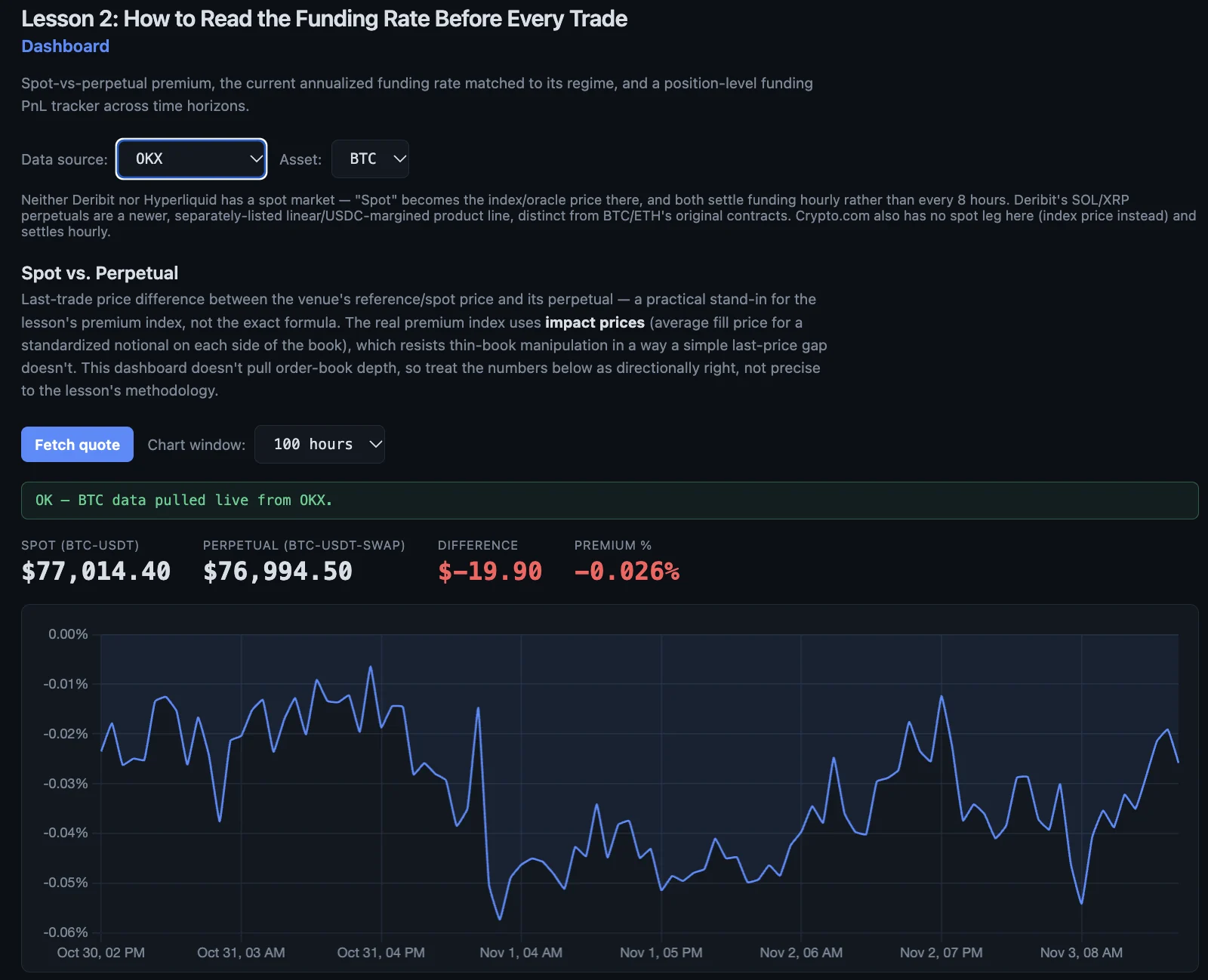
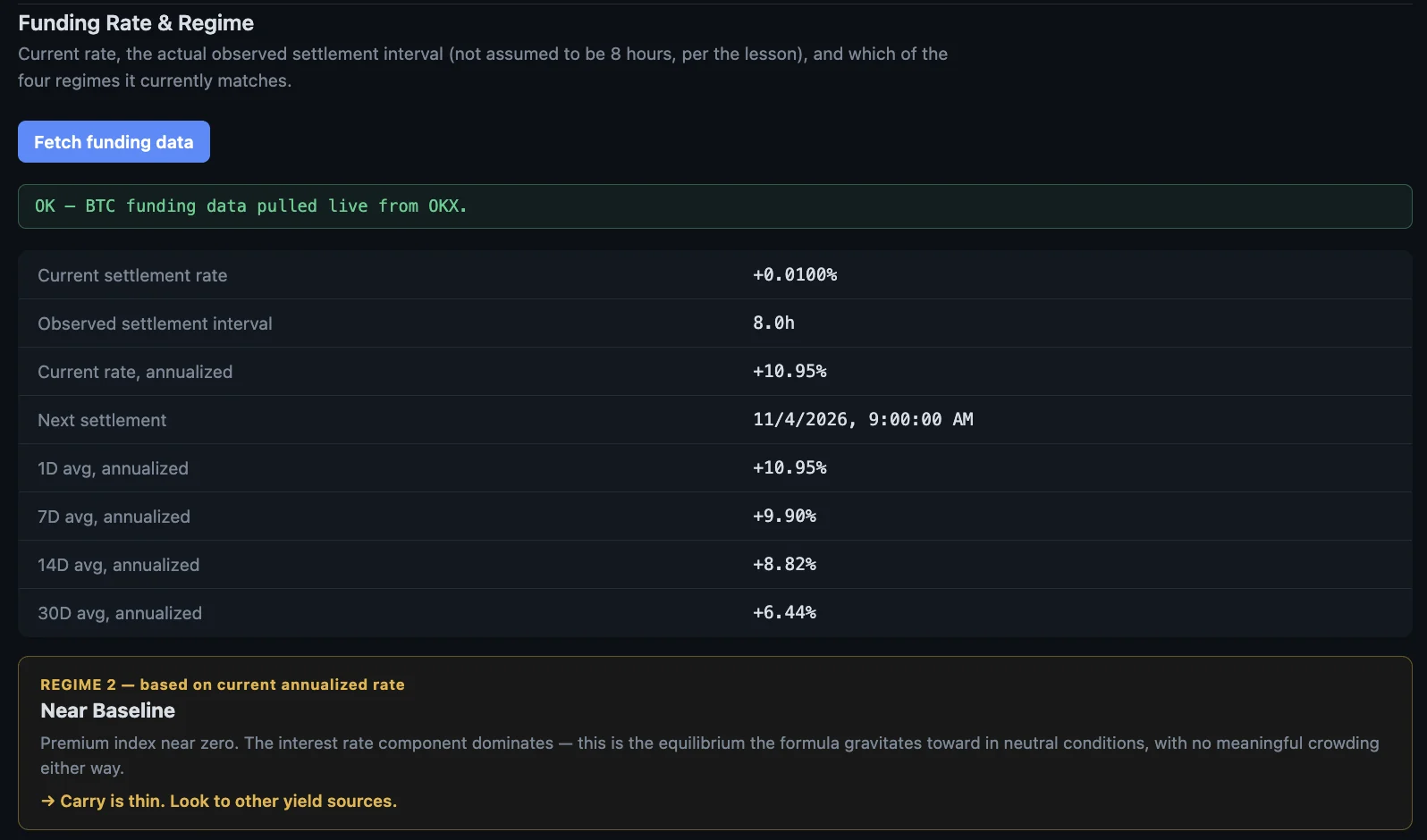
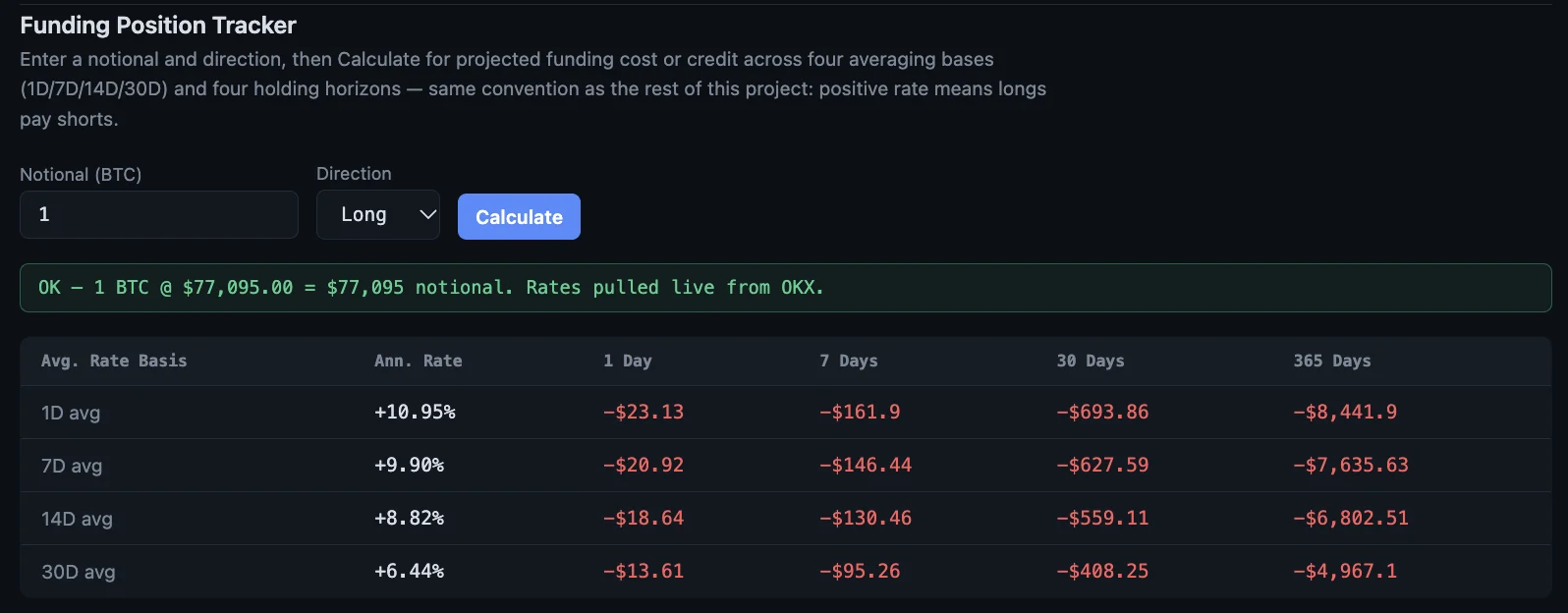
The lessons, the live lesson tools and the core curriculum are part of Harmonic Academy, along with the weekly briefs.
How to trade perpetual futures, step by step
Going long means you profit when the price rises. Going short means you profit when it falls. Before you open any perpetual position:
- Decide your direction, long or short, and write down why before you look at the order screen.
- Select isolated margin. It limits your maximum loss to the margin allocated to this one trade.
- Choose your leverage. Start at 3x or lower, and calculate your liquidation price with the exchange’s calculator before you confirm.
- Check the current funding rate. Multiply it by 3 for the daily rate and by 365 for the annualized cost. If you are long and annualized funding is above 50%, factor that carry cost into how long you plan to hold.
- Set your stop-loss at a technical level, not at your liquidation price. Your stop should trigger well before liquidation does.
- Check open interest, the long-to-short ratio and recent liquidation clusters near the current price.
How to short Bitcoin
Unlike shorting in a spot market, shorting a perpetual requires no borrowing. You open a short position, and you profit if the price falls. Check the funding rate before you do, because shorts pay when funding is negative.
Margin and leverage basics for perpetuals
Margin is the collateral you post to open a position, and leverage is how many times larger the position is than that margin. As a rule of thumb, 3 to 5x leaves you a buffer to manage a position actively. Above 10x, a single volatile candle can trigger liquidation before you can react. For your first trades, use a USD-settled contract with isolated margin. The full explanation is in our guide to margin, liquidation and risk management.
What can go wrong
- Funding flips and adds up. A rate that is positive when you open can turn negative, and a small rate paid every few hours compounds into a real cost over weeks.
- Liquidation. If your margin falls to the maintenance threshold, the exchange closes the position automatically. The liquidation price is roughly your entry price minus your margin per unit for a long, and your entry price plus margin per unit for a short. Know it before you open the trade.
- Crowded leverage. In May 2021, funding ran above 0.05% per 8-hour period for weeks, over 50% annualized, with open interest at record highs. When Bitcoin fell from about $58,000 to below $30,000, over $10 billion in positions were liquidated in a week.
- Exchange differences. Payment intervals and funding formulas vary by exchange. Always check the rules for the contract you are trading.
Frequently asked questions
What is a perpetual future?
A perpetual future is a futures contract with no expiry date, so you can hold it for as long as you keep enough margin in the account. Because there is no settlement date to pull its price back to spot, exchanges use a funding rate instead. Most crypto derivatives volume now flows through perpetuals.
What is a funding rate in crypto?
A funding rate is a periodic payment that flows directly between traders who are long and traders who are short. It is built from a premium index, which measures how far the perpetual trades from spot, plus an interest rate component. The exchange does not keep the payment.
Who pays the funding rate, longs or shorts?
It depends on the sign of the rate. When funding is positive, the perpetual is trading above spot and longs pay shorts. When funding is negative, the perpetual is trading below spot and shorts pay longs.
What happens when the funding rate is negative?
Shorts pay longs, and a long position receives a payment each period instead of paying one. A negative rate means the perpetual is trading below spot, which usually points to crowded shorts. Negative funding has historically been short lived, because the formula’s positive bias and arbitrage capital push the rate back toward positive territory.
How often is funding paid?
It depends on the exchange and the contract. Many Bitcoin perpetuals settle every 8 hours, while some exchanges offer 1, 2 or 4 hour intervals and others settle every hour. Check the interval before you trade, because it changes how you annualize the rate.
How do I short Bitcoin with perpetual futures?
You open a short position, and unlike shorting in a spot market, it requires no borrowing. A short profits when the price falls. Use isolated margin and low leverage, and check the funding rate first, because shorts pay when funding is negative.
Are perpetual futures suitable for beginners?
Perpetual futures carry a high risk of loss because leverage can turn a small price move into a liquidation. A beginner should understand margin, the liquidation price and the funding cost before opening any position. Starting at 3x leverage or lower with isolated margin limits the damage from a mistake.
Go deeper in Harmonic Academy. The community has the weekly briefs, and the core curriculum, the lessons and the live lesson tools are there too.
Join Harmonic AcademyRelated guides
- Margin, Liquidation & Risk Management
- Earn Yield on Bitcoin
- What Are Crypto Derivatives?
- Weekly Crypto Market Brief
Education only. Not financial advice. Trading derivatives carries a high risk of loss. The figures on this page are illustrative and are not a prediction or a promise of any result.