Home / Learn / Earn Yield on Bitcoin
How to Earn Interest on Bitcoin: Carry, Basis and Funding Trades
Risk disclosure. Education only. Not financial advice. Trading derivatives carries a high risk of loss. Yields from these strategies are not interest paid by a lender. They are not fixed or promised, and you can lose money.
Short answer
In a cash-and-carry trade, you hold Bitcoin and sell an equal amount of a futures contract against it. The futures price usually sits above spot, and that gap, called the basis, shrinks to zero at expiry, so you collect it without betting on direction. The main risks are margin on the short leg, funding flips and exchange risk.
- Ways to earn on Bitcoin
- What is the basis?
- Cash-and-carry trade step by step
- Worked example
- The crypto carry trade and funding carry
- Funding rate arbitrage
- Earn dashboard
- What can go wrong
- FAQ
Ways to earn on Bitcoin
Bitcoin does not pay interest on its own. If you want to put it to work, there are two broad routes. You can lend it, or you can earn yield from the way derivatives are priced. The search term is usually “interest,” but only one of these routes involves a borrower paying you interest.
| Lending | Derivatives-based yield | |
|---|---|---|
| Who pays you | A borrower, through a platform | The market: the futures premium, or funding paid by traders on the other side |
| What you give up | You hand your coins to the platform | You keep your Bitcoin and post margin on the derivative leg |
| Main risk | The platform or borrower fails to repay | Margin on the hedge, funding that moves against you, and exchange risk |
| How the rate is set | By the platform | By the basis or the funding rate at the time you trade |
The second route needs no lending platform. Professional traders have used it for years to earn a steady yield from the relationship between the derivative price and the spot price, with no directional bet required. The rest of this guide explains how it works and what can go wrong.
What is the basis?
The basis is the gap between an expiring futures contract’s price and the spot price. Before the contract expires, it trades at a premium or a discount to spot. At expiry the two prices become the same, so the basis converges to zero whatever spot does in the meantime. That convergence is predictable, and it is what a carry trade collects.
- Contango. Futures trade above spot. This is the normal condition in a bullish or neutral market, and it is what a carry trade needs.
- Backwardation. Futures trade below spot. It shows up in bearish markets or periods of high fear.
- Convergence. The basis shrinks to zero by the expiry date.
Perpetual futures have no expiry, so they cannot converge in the same way. The funding rate does the same job, and it is the carry on the perpetual side. Our guide to perpetual futures and funding rates explains how it works.
Cash-and-carry trade step by step
This is the crypto futures cash and carry trade in its simplest form. You own the asset, you sell the futures against it, and you collect the basis. The spot leg and the futures leg cancel each other’s price risk, which is what delta neutral means.
- Check the environment. High funding and a wide basis mean carry is open. Low funding and a narrow basis mean it is thin.
- Annualize the basis of the futures contract you are considering, so you can compare it with other yields and with your costs.
- Confirm the locked yield clears your trading fees on both legs. If it does not, skip the trade.
- Buy spot Bitcoin. This is the spot leg.
- Sell an equal notional amount of the futures contract. This is the futures leg. Because the two legs offset each other’s price moves, the position is delta neutral.
- Hold to expiry. The futures price converges to spot, and the basis you sold is the yield you collect.
Because you hold the spot Bitcoin the whole time, you still own it when the trade ends. The yield is the premium you sold, and you earn it whether Bitcoin rises or falls over the period.
Worked example
Example from Harmonic’s Lesson 3
Bitcoin spot is $66,500. The quarterly futures contract trades at $67,400 with 74 days to expiry.
| Step | Calculation | Result |
|---|---|---|
| The basis in dollars | $67,400 − $66,500 | $900 per Bitcoin |
| The basis as a share of spot | $900 ÷ $66,500 | about 1.35% |
| Annualized | 1.35% ÷ (74 ÷ 365) | about 6.7% a year |
The formula is: annualized basis = ((futures − spot) ÷ spot) ÷ (days to expiry ÷ 365). In this example you hold 1 Bitcoin and sell 1 Bitcoin of the futures. If both legs are held to expiry, the $900 premium is the gross yield, before trading fees. It is locked in when you enter, so it does not change if funding moves. These figures are illustrative, not a prediction or a promise.
The crypto carry trade and funding carry
A crypto carry trade can use either of two instruments. They price the same spread differently.
| Dated future | Perpetual | |
|---|---|---|
| What you collect | The basis | The funding payment from longs |
| Type of rate | Fixed. Locked at entry and decays to zero at expiry | Floating. Resets every funding period and can rise or fall |
| Ends | At expiry | Whenever you close it |
The perpetual version is called funding carry. You hold spot Bitcoin and short the perpetual in equal notional. When funding is positive, longs pay shorts, so your short collects the payment every period. At 0.03% every 8 hours, that is about 32.85% a year. The catch is that the rate floats for as long as you hold the position, and nothing locks it in.
Which instrument pays more changes over time. A measure called basis net of carry compares them: it is the annualized perpetual funding rate minus the annualized expiry basis. A positive number means the perpetual is paying carry more richly than the expiry.
Funding rate arbitrage
Funding rate arbitrage is the same position seen as a trade on the funding rate. You are long spot and short the perpetual, so your price risk is hedged and what remains is the funding payment. When funding is high, the trade pays well. When funding is near its baseline of about 0.01% every 8 hours, or roughly 11% a year, the carry is thin and may not cover costs. A common rule of thumb is that above 15 to 20% a year the carry is open on the perpetual leg, and below about 12% it is thin after execution costs.
Arbitrage capital is why funding does not stay high. Traders collecting the payment push the rate back toward its baseline. Even so, funding can stay elevated for a long time. In the third quarter of 2025, as Bitcoin approached $100,000, perpetual funding stayed above 0.05% per 8-hour period, which is 54.75% annualized, for weeks.
Funding differences between exchanges
Funding rate arbitrage can also run across exchanges. The same instrument often pays a different funding rate on different venues. You go long on the venue that pays you, or charges you less, and short on the venue that charges more. You collect the difference every settlement, for as long as the spread holds.
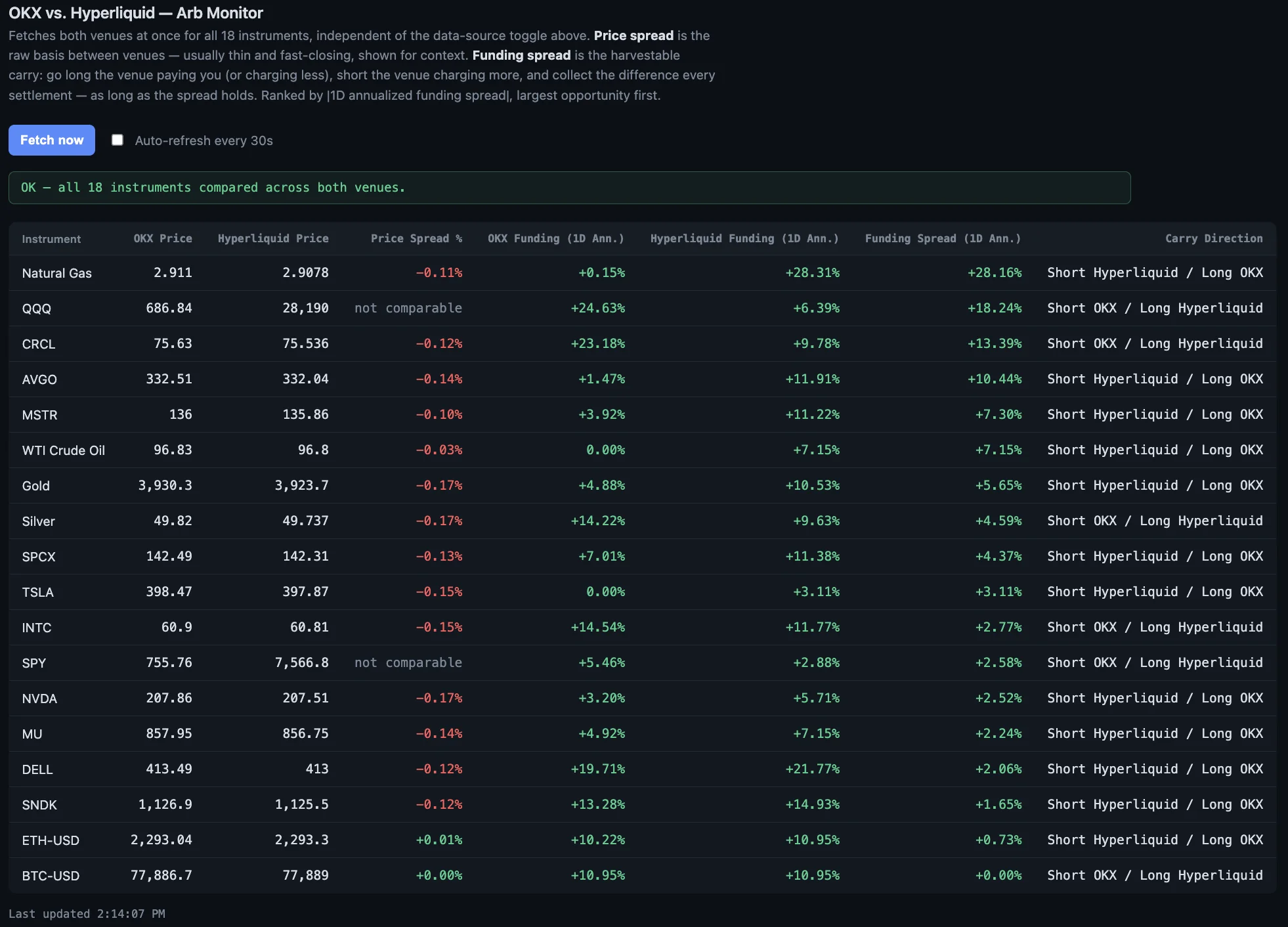
In this capture, natural gas topped the list with a one-day funding spread of +28.16% annualized, and the carry direction was to short Hyperliquid and long OKX. For Bitcoin, the spread was 0.00%. The dashboard calls this a screening signal and not a fill, so check the tradeable size and fees on both venues before acting.
How funding flips affect it
Funding does not have to stay positive. If it turns negative, the direction of payment reverses. Your short perpetual then pays the longs, and income becomes a cost. Negative funding has historically been short lived, but it can last long enough to hurt, which is the main reason a floating rate trade needs watching. A dated future avoids this, because its basis is fixed when you enter.
Earn dashboard
Harmonic Academy has an Earn dashboard built for this lesson. You choose the exchange, the asset and a notional size, and it shows two ways to run the trade:
- A perpetual with floating funding. It collects funding as long as the rate stays positive, and the rate moves with the market.
- A dated future with a fixed basis. The basis is locked in the moment you enter, for the full holding period.
The dashboard covers OKX, Deribit, Crypto.com and Hyperliquid, for BTC, ETH, SOL and XRP. Here it is on Crypto.com for 1 Bitcoin.
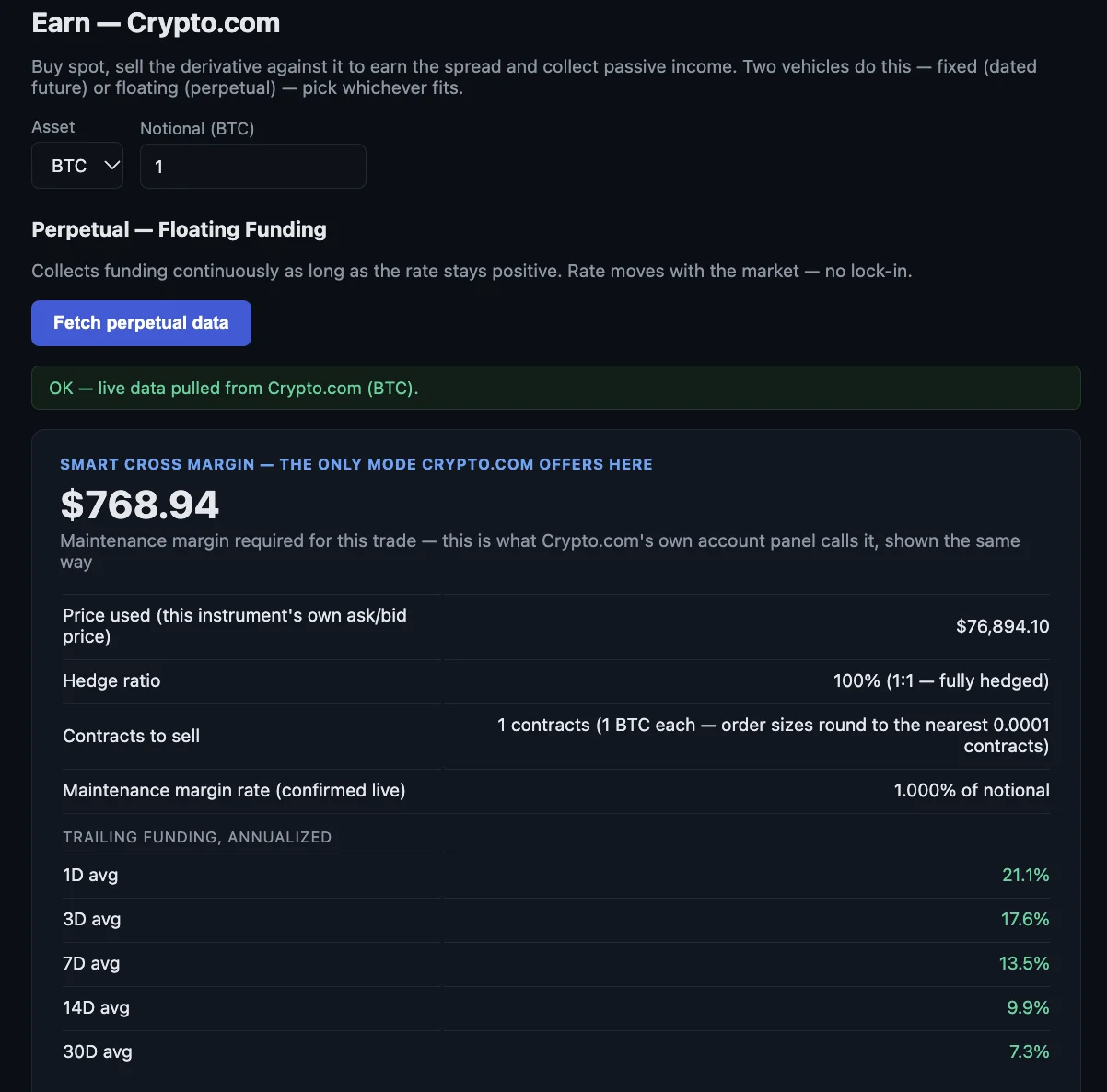
On the floating side, the dashboard shows trailing funding, annualized, averaged over 1, 3, 7, 14 and 30 days. In this capture the averages ran from 21.1% over one day down to 7.3% over thirty days, which shows how quickly a floating rate can change.
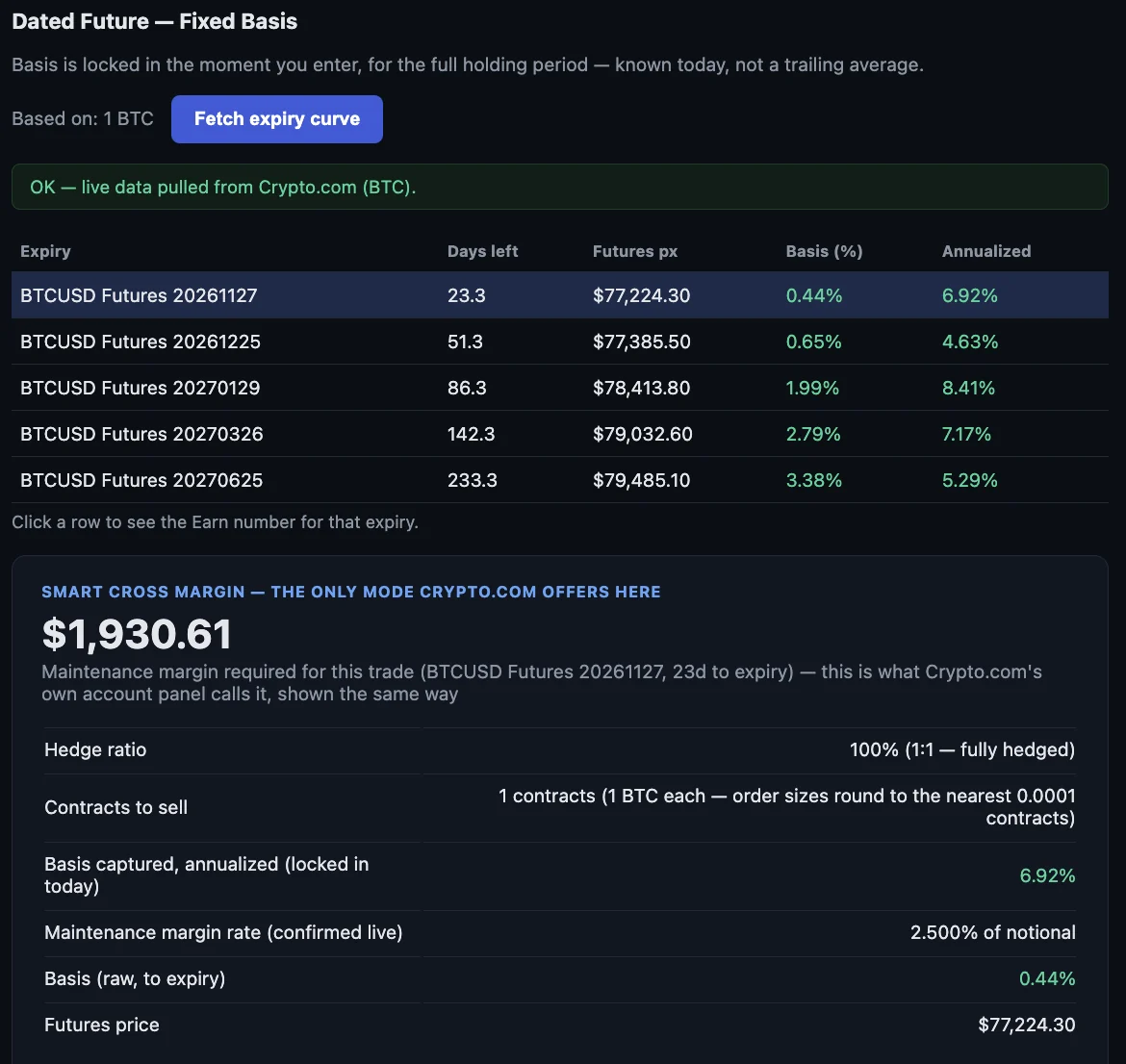
On the fixed side, it lists each expiry with its annualized basis. In this capture the five contracts ranged from 4.63% to 8.41%, and the contract expiring on November 27 locked in 6.92%.
The dashboard also shows a risk figure for each exchange. For a matched hedge, a simple liquidation price is usually the wrong question, because spot and the short move together almost exactly. Each exchange shows something different instead:
| Exchange | What the dashboard shows | How to read it |
|---|---|---|
| OKX | A margin ratio: equity ÷ requirement | Higher is safer, and danger is at 100% and below. It can be a very large percentage, because the requirement for a matched hedge is tiny |
| Deribit | A margin ratio: maintenance margin ÷ equity | Lower is safer, and danger is at 100% and above |
| Crypto.com | The minimum margin balance, in dollars | Liquidation triggers if your margin balance falls below it |
| Hyperliquid | A real liquidation price | Only 50% of the value of your spot counts as collateral there, so a price level is meaningful |
The same position run in the opposite direction is a self-directed borrow, which our guide to borrowing against crypto covers. The lessons, the live lesson tools and the core curriculum are part of Harmonic Academy, along with the weekly briefs.
What can go wrong
- Margin and liquidation. The two legs offset on price, but the short leg is its own position and needs enough margin to stay open. Read the margin rules for your exchange before you size the trade, and see our margin, liquidation and risk management guide.
- Funding flips. On the perpetual version, a positive rate can turn negative and turn your income into a cost.
- Costs. There are fees on both legs, and a thin yield can disappear after they are paid.
- Exchange risk. Your spot and your derivative positions sit on an exchange. You do not need a lending platform, but you still depend on the exchange you use.
- Closing early. At expiry the future settles at the spot price. Before expiry, it can trade higher or lower than spot, so if you close earlier you may not capture all of the fixed yield.
- Taxes. Tax treatment depends on your cost basis and domicile. This is not tax advice, so consult a professional.
Frequently asked questions
How can I earn interest on Bitcoin?
There are two broad routes. You can lend your Bitcoin to a platform or borrower who pays you interest, which means you rely on that counterparty. Or you can earn yield from market structure by holding Bitcoin and selling a derivative against it, which this guide covers. Both routes carry risk, and returns are not fixed or promised.
What is a cash-and-carry trade?
A cash-and-carry trade holds the underlying asset and sells an equal amount of a futures contract against it. The futures usually trades above spot, and that premium shrinks to zero at expiry, so you collect it whichever way the price moves. It is called a carry trade because you are paid to carry the position.
How is annualized basis calculated?
Annualized basis = ((futures price − spot price) ÷ spot price) ÷ (days to expiry ÷ 365). For example, a futures price of $67,400, a spot price of $66,500 and 74 days to expiry gives a basis of about 6.7% annualized. Annualizing lets you compare contracts with different expiry dates.
What is a crypto carry trade?
A crypto carry trade earns the gap between the derivative price and the spot price while the underlying position is hedged. It can use a dated future, where the basis is locked at entry, or a perpetual, where you collect funding. The environment tells you whether carry is attractive, based on how high funding and the basis are.
What is funding rate arbitrage?
Funding rate arbitrage is the perpetual version of the carry trade. You hold spot and short an equal notional of the perpetual, and you collect the funding payment that longs pay shorts when funding is positive. It is a floating rate trade, so the income changes with the market and can turn into a cost if funding flips negative.
What are the risks of a carry trade?
The main risks are margin and liquidation on the hedge leg, funding that moves against you, trading costs that eat a thin yield, and exchange risk, because your positions sit on an exchange. The two legs offset on price, but they are separate positions that each need to be managed. Yields are not fixed or promised, and you can lose money.
Go deeper in Harmonic Academy. The community has the weekly briefs, and the core curriculum, the lessons and the live lesson tools are there too.
Join Harmonic AcademyRelated guides
Education only. Not financial advice. Trading derivatives carries a high risk of loss. The figures on this page are illustrative and are not a prediction or a promise of any result.