How to Borrow Against Crypto: Should You Borrow or Sell Your Bitcoin?
Risk disclosure. Education only. Not financial advice. Trading derivatives carries a high risk of loss. Borrowing against crypto can lead to forced liquidation, and you can lose money.
Short answer
Borrow when you need dollars but want to keep your exposure to the price. Sell when you want out of the position. Both carry risk. Selling gives up future gains, while borrowing can lead to forced liquidation if the price falls far enough.
- How borrowing against crypto works
- Liquidation risk and the buffer
- Borrow vs sell
- Borrow calculator
- Step-by-step example
- Risks
- FAQ
Should I borrow against my bitcoin or sell it? It comes down to what you want from the position. If you need dollars but still want your exposure to the price, borrowing keeps it. If you want out, selling is cleaner. This guide shows how to borrow against crypto, what the main risks are, and how the two choices compare.
How borrowing against crypto works
There are two ways to get dollars without selling all of your Bitcoin.
A loan from a lender. You pledge your crypto as collateral, and the lender gives you cash. The key terms are the collateral, the loan-to-value, and the interest. Loan-to-value (LTV) is the amount you borrowed divided by the value of your collateral. The lender sets the interest rate. The lender holds your collateral. If the LTV reaches a set level, you get a margin call, and if you cannot meet it, the lender liquidates you.
A self-directed borrow. There is no lender. You sell part of your spot Bitcoin for cash, and you use the rest as collateral for a long position in a derivative, sized to replace the exposure you sold. In the Harmonic Borrow dashboard, the loan-to-value target is the share of your Bitcoin that you sell, so a 70% target means you sell 0.7 BTC and keep 0.3 BTC as margin. Your price exposure stays the same, and your cost is either funding on a perpetual or the basis on a dated future. It is the same position as a carry trade, entered from the opposite side. You can always add more assets to widen your liquidation price. If you do not meet a margin call or add margin, the exchange liquidates you when loan-to-value, as its own margin calculator measures it, reaches about 99 percent. Our guide to earning yield on Bitcoin explains the carry side.
| Loan from a lender | Self-directed borrow | |
|---|---|---|
| Who provides the cash | A lender | You, by selling part of your spot |
| What you pledge | Your crypto, held as collateral | The spot you keep, as margin for a long derivative position |
| What it costs | Interest set by the lender | Funding on a perpetual, or a fixed basis on a dated future |
| Main risk | A margin call at a set LTV, and liquidation if you cannot meet it | The long position is liquidated if the price falls far enough, though you can add assets to widen the liquidation price |
Liquidation risk and the buffer
A self-directed borrow is directional, not hedged. You sold part of your spot and replaced it with a leveraged long, so there is no offsetting position to cancel a fall in price. That means the position has a real liquidation price, and you can work it out before you start.
Calculate it before you withdraw any cash. Then confirm there is at least a 20 to 30% buffer between the current price and the liquidation price, and size the amount you take out to keep it. A buffer matters because crypto can move that far quickly. In May 2021, Bitcoin fell from about $58,000 to below $30,000 in three weeks, a decline of 47%. The exchange does not wait for you. If you have not added margin by the time the limit is reached, it closes the position automatically.
A lower loan-to-value target gives you more room, because you sell less and keep more Bitcoin as margin. In the dashboard example, a 70% target puts the liquidation price 29.1% below the price used. Our guide to margin, liquidation and risk management shows how to calculate a liquidation price.
Borrow vs sell: comparison table
Tax and cost depend on your situation, so this table describes them in general terms only.
| Borrow (self-directed) | Sell | |
|---|---|---|
| Keeps your price exposure | Yes, through the long futures position | No. You are out of the position |
| Raises cash | Yes, from the portion of spot you sell | Yes, from the whole amount you sell |
| Ongoing cost | Funding on a perpetual, or a fixed basis on a dated future, plus fees on both legs | None after the sale |
| Liquidation risk | Yes, on the long futures position | None |
| Tax | Depends on your cost basis and domicile | Depends on your cost basis and domicile |
| It fits when | You need dollars and want to stay in the trade | You want to exit, or you do not want the risk of liquidation |
Tax treatment depends on your cost basis and domicile. This is not tax advice, so consult a professional.
Borrow calculator
Harmonic Academy has a Borrow dashboard that works the structure out for you. You choose the exchange, the asset, the notional amount and the loan-to-value you want, and it shows the numbers for both instruments. It covers Deribit, OKX and Crypto.com. Here is what each input means:
| Input | What it means |
|---|---|
| Exchange | The venue where you would run the position. Each has its own margin mechanics, so the liquidation price is worked out differently for each |
| Asset | BTC, ETH, SOL or XRP. Some assets use different margin rules, for example a haircut on the spot you keep as collateral |
| Notional | The size of the holding you are borrowing against |
| Loan-to-value target | How much cash you want to raise relative to your holding. It is yours to set, and a lower number leaves a bigger buffer |
| Instrument | A perpetual, where the cost floats with funding, or a dated future, where the cost is fixed at entry |
For each exchange, the dashboard shows the exact amount of spot to sell and the exact amount to keep, in the asset’s own units and not only in dollars, together with a real liquidation price. The lessons, the live lesson tools and the core curriculum are part of Harmonic Academy, along with the weekly briefs.
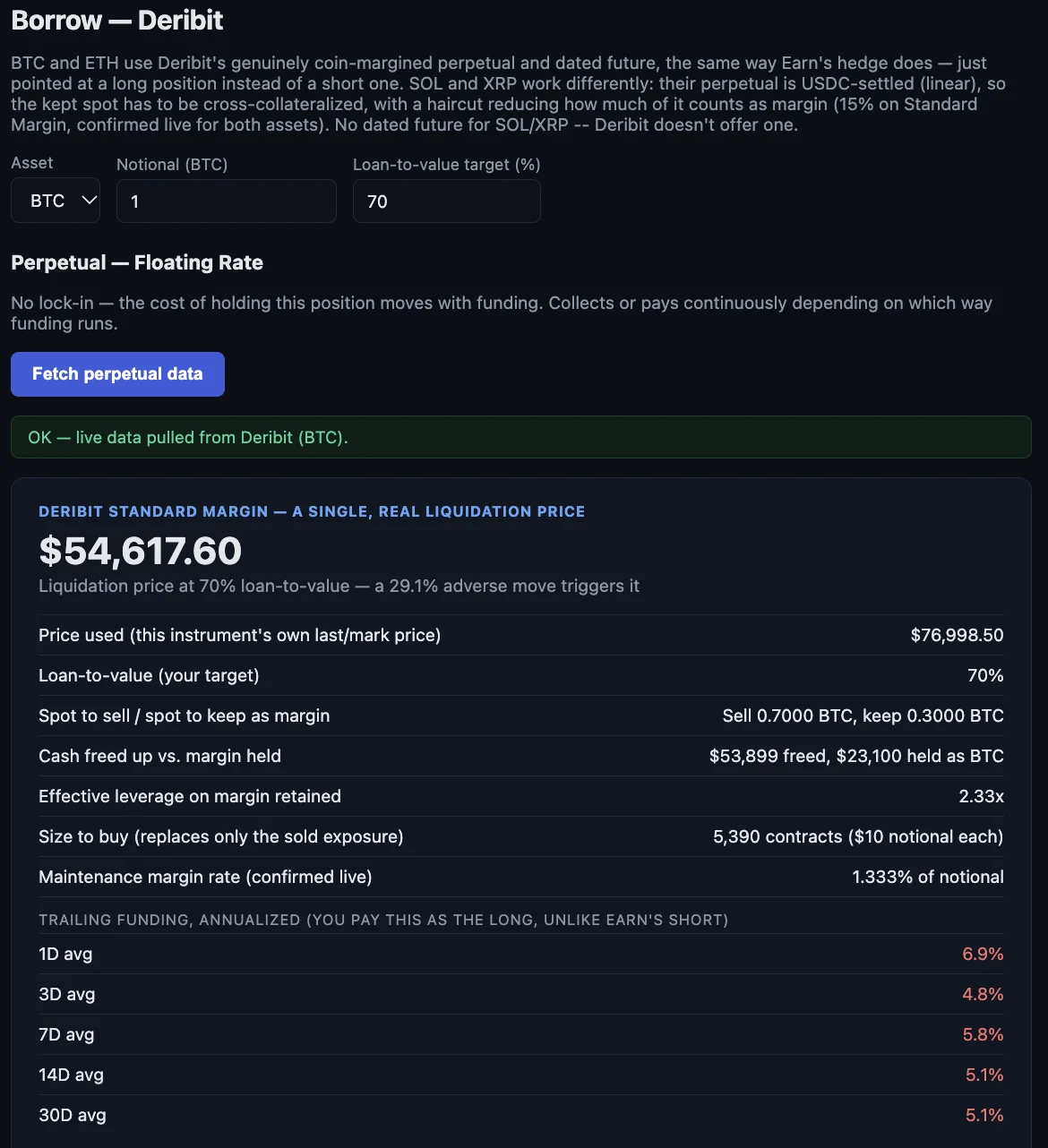
In this capture, the dashboard says to sell 0.7000 BTC and keep 0.3000 BTC as margin, which frees up $53,899 of cash. It shows a liquidation price of $54,617.60, a 29.1% adverse move from the $76,998.50 price used, and the funding you pay as the long, which averaged between 4.8% and 6.9% annualized. A 29.1% buffer is inside the 20 to 30% range the lesson recommends.
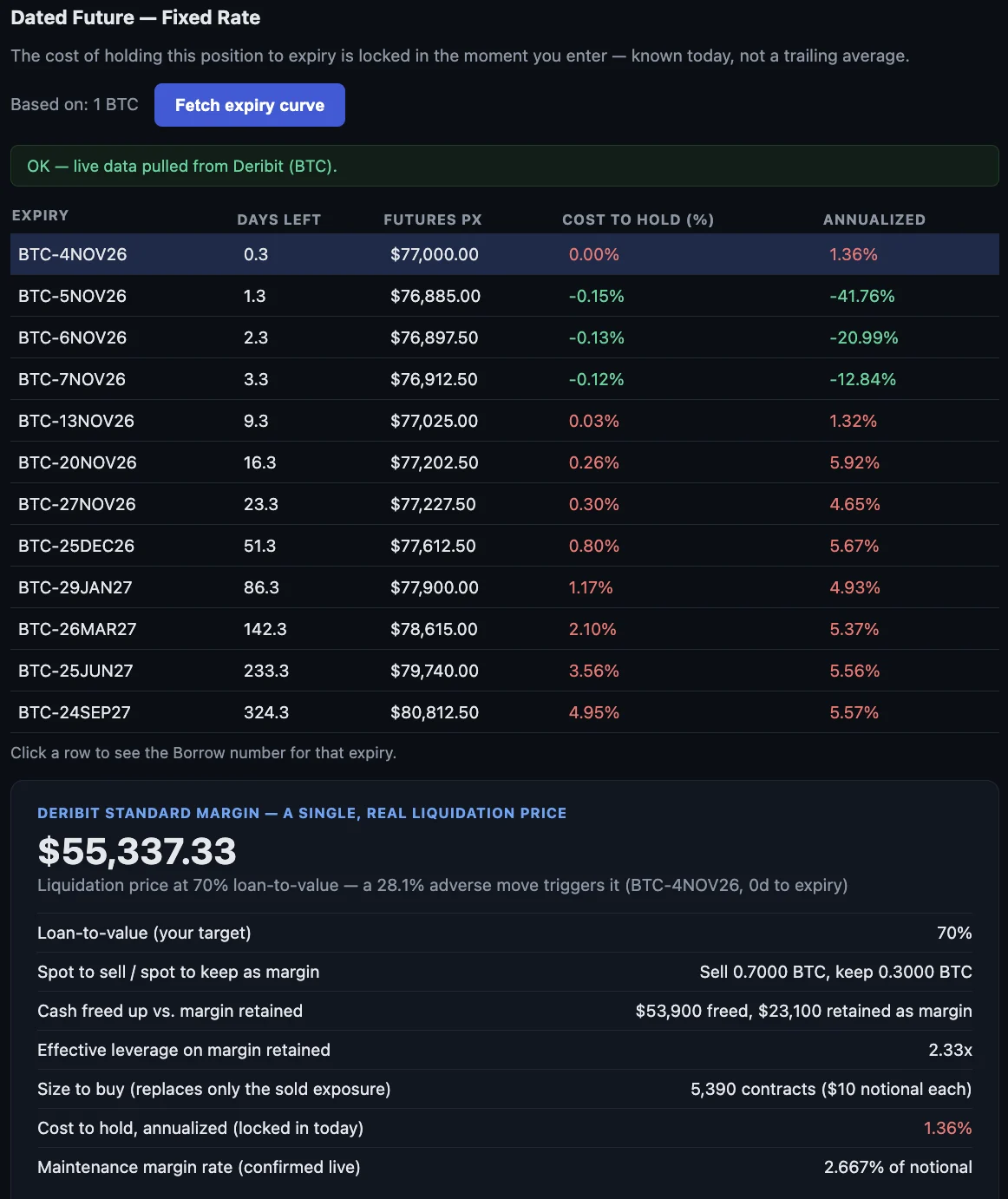
On the fixed side, the dashboard lists each expiry with its annualized cost to hold, and it gives the liquidation price for the one you select. For the BTC-4NOV26 contract selected in this capture, it showed a liquidation price of $55,337.33 and a locked cost of 1.36% annualized.
Step-by-step example
Example from the Harmonic Academy Borrow dashboard
You hold 1 Bitcoin, priced at $76,998.50 on Deribit, and set a 70% loan-to-value target. That means you sell 70% of your Bitcoin and keep 30% as margin.
| Step | What you do | Result |
|---|---|---|
| 1 | Sell 0.7000 BTC | $53,899 in cash |
| 2 | Buy 5,390 perpetual contracts, $10 of notional each | $53,900 of long exposure, which replaces only the 0.7 BTC you sold |
| 3 | Keep 0.3000 BTC as margin | $23,100 of Bitcoin held as margin, an effective leverage of 2.33x on that margin |
| 4 | Check the liquidation price | $54,617.60, a 29.1% adverse move from $76,998.50 |
| 5 | Choose the instrument and work out the cost | The perpetual’s trailing funding, which you pay as the long, averaged 4.8% to 6.9% annualized. The December 25 dated future costs about 0.80% to hold to expiry, or 5.67% annualized |
On the December 25 future, the cost is about 0.80% of the $53,900 of notional, roughly $431, and it is locked in when you enter. A perpetual floats with funding, so it can cost more or less. The 29.1% buffer to the liquidation price is inside the 20 to 30% range the curriculum asks for. The 0.3 BTC you keep is still Bitcoin, so it moves with the price too.
The steps in order:
- Check the environment. Low funding and a narrow basis make borrowing cheap. High funding and a wide basis make it expensive.
- Choose the instrument. A perpetual has a floating cost. A dated future locks the cost in at entry.
- Calculate the liquidation price on the long futures leg before you withdraw any cash.
- Confirm at least a 20 to 30% buffer between the current price and the liquidation price, and size the sale to keep it.
- Sell the portion of your spot you need to raise the cash, and buy the same notional amount in futures.
- Withdraw the cash, and monitor the position until you close it.
Risks
- A fall in price. You still hold price exposure, and your collateral loses value as the price drops. A large enough fall brings the long position to its liquidation price.
- Rate changes. A perpetual’s cost floats with funding and can rise. A dated future fixes the cost at entry for the holding period.
- Forced liquidation. The exchange closes the position automatically at the liquidation price, and you lose the margin in that position.
- Costs and fees. You pay fees on both the spot sale and the futures position, and the financing cost on top.
- Exchange risk. Your positions and your remaining spot sit on an exchange, so you depend on it.
- Taxes. Tax treatment depends on your cost basis and domicile. This is not tax advice, so consult a professional.
Frequently asked questions
How do I borrow against my crypto?
There are two routes. You can pledge your crypto to a lender as collateral and receive a loan, or you can run a self-directed borrow, where you sell part of your spot for cash and hold a long futures position to keep your exposure. This guide focuses on the second route, which needs no lender.
What is loan-to-value (LTV)?
For a lender, loan-to-value is the amount you borrowed divided by the value of the collateral backing it. In the Harmonic Borrow dashboard, the loan-to-value target is the share of your Bitcoin that you sell, so a 70% target means you sell 0.7 BTC and keep 0.3 BTC as margin. A lower target means a bigger cushion before liquidation becomes a risk.
What happens if my collateral price falls?
Your long position and the Bitcoin you kept as margin both lose value. If the price falls far enough, the position reaches its liquidation price and is closed automatically if you have not added margin by then. You can add more assets to widen the liquidation price. Calculating it before you borrow, and keeping a buffer, is how you prepare.
Should I borrow against Bitcoin or sell it?
Borrow if you need dollars but want to keep your exposure to Bitcoin’s price. Sell if you want out of the position. Neither is without risk, and the better choice depends on your goals, your costs and your tax situation.
How big a liquidation buffer should I keep?
Harmonic’s curriculum uses at least a 20 to 30% buffer between the current price and the liquidation price. Crypto can fall that far in a short time, and the buffer gives you room to act. Size the amount you withdraw to preserve it.
Is borrowing against crypto taxable?
It depends on the structure and on your situation. Tax treatment depends on your cost basis and domicile. This is not tax advice, so consult a professional.
Go deeper in Harmonic Academy. The community has the weekly briefs, and the core curriculum, the lessons and the live lesson tools are there too.
Join Harmonic AcademyRelated guides
Education only. Not financial advice. Trading derivatives carries a high risk of loss. The figures on this page are illustrative and are not a prediction or a promise of any result.