How to Hedge Your Crypto: Protective Puts, Spreads and Futures
Education only. Not financial advice. Trading derivatives carries a high risk of loss.
Short answer
Hedging means taking a second position that gains when your main holding falls, so your downside is smaller. To hedge a Bitcoin portfolio with put options, buy a put at a strike below today’s price. If Bitcoin falls, the put gains value and offsets part of the loss. Hedging reduces downside risk. It does not remove it.
So how do I hedge my crypto? There are three common ways. You can buy a put option, which is a protective put. You can use a spread or a collar to lower what the put costs. Or you can short futures against the coins you hold. This guide shows each with numbers, then compares them.
- What does it mean to hedge?
- Protective put example
- Hedging with spreads
- Hedging with futures
- Hedge comparison table
- How much should I hedge?
- Risks and limits of hedging
- FAQ
What does it mean to hedge?
To hedge is to reduce your downside, not to remove your risk. You hold something you want to keep, such as Bitcoin, and you add a second position that moves the other way when the price falls. The second position costs something, and it can limit what you gain. That trade-off is the whole idea: you pay a known cost to avoid a bigger unknown loss.
Harmonic’s curriculum calls the options version an overlay. An overlay is applied to a position you already hold, so the spot holding is the main trade and the option changes its risk profile. Most retail participants with spot holdings start with overlays, because the downside is bounded by the premium cost and the spot they already own. Institutional holders use the same tools to hedge large positions during macro uncertainty without selling the underlying.
Protective put example
A bitcoin protective put is a put option you buy while holding Bitcoin. A put gives you the right to sell at a set price, called the strike. If Bitcoin falls sharply, the put gains value and offsets the loss on your spot. If Bitcoin stays flat or rises, the put expires worthless, and the premium you paid is the cost of the insurance. A common rule of thumb in the curriculum is to buy a put 5 to 10% below the current price and to choose an expiry that covers the event you are worried about.
Example from Harmonic’s Lesson 8
Bitcoin is around $77,000, with 45 days to expiry. Lesson 8 quotes the $68,000 put at 0.0149 BTC, about $1,146. Suppose you hold 1 Bitcoin and buy that put as a hedge. The strike is about 12% below the price, deeper than the usual 5 to 10%, which keeps the premium lower.
- Worst case: ($77,000 − $68,000) + $1,146 = $10,146, which is about 13% of the position.
- Break-even: $77,000 + $1,146 = $78,146, which is today’s price plus the premium.
| Bitcoin at expiry | Spot alone | Spot plus put, after the premium |
|---|---|---|
| $85,000 | +$8,000 | +$6,854 |
| $78,146 (break-even) | +$1,146 | $0 |
| $77,000 | $0 | −$1,146 |
| $68,000 (the strike) | −$9,000 | −$10,146 |
| $60,000 | −$17,000 | −$10,146 |
The put does its job on the way down. At $60,000, the spot has lost $17,000, but the put pays $8,000 and the premium costs $1,146, so the combined loss stops at $10,146. On the way up, you keep all of the gain except the $1,146 premium. The price of protection is that $1,146 is gone if the put expires worthless.
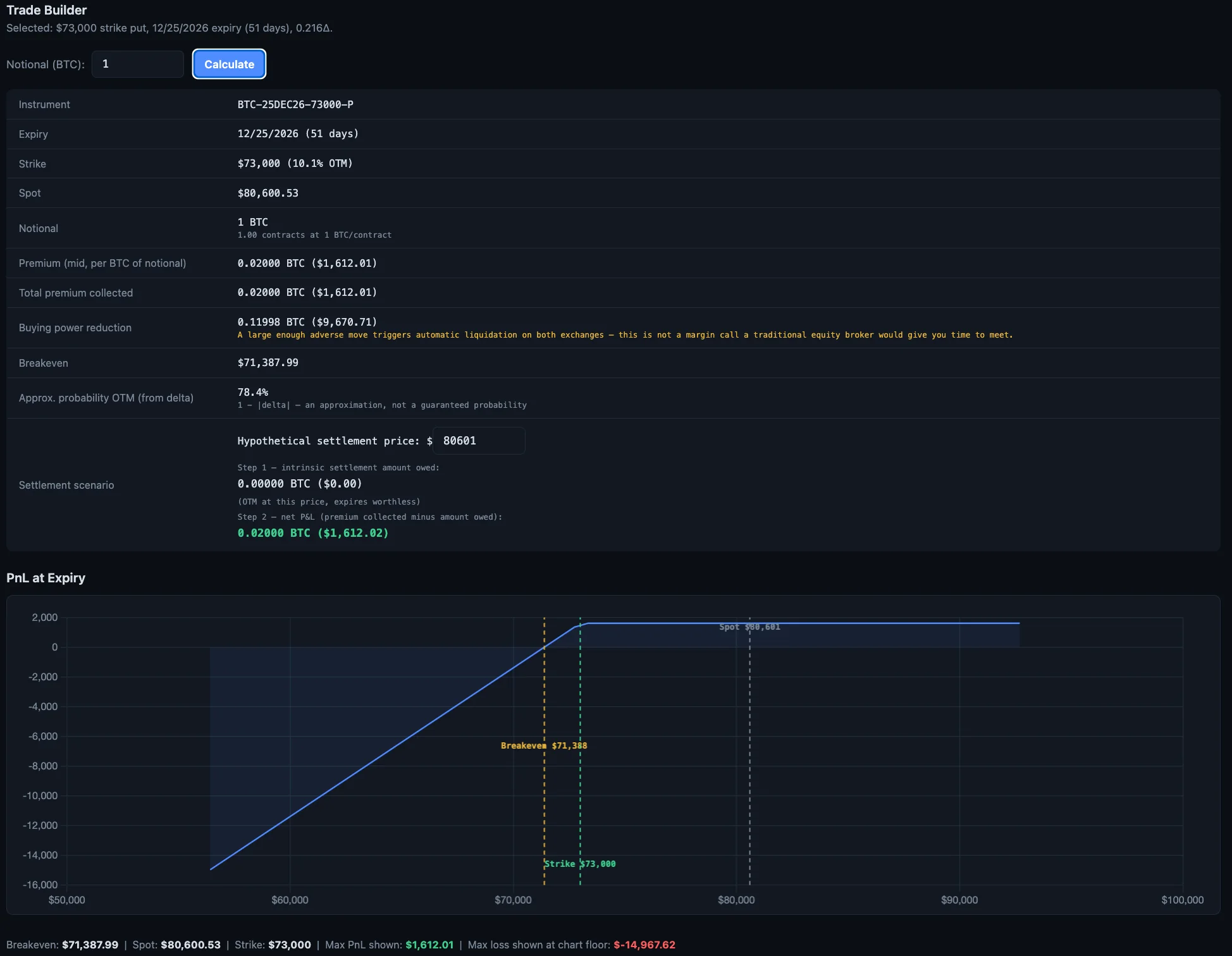
The Lesson 8 dashboard shows the seller’s side of this trade. In this capture, selling the $73,000 put collects about $1,612. A hedger who buys the same put pays about that amount instead, and the payoff flips. The loss the seller takes below the strike becomes the protection the buyer receives, and the premium the seller collects becomes the premium the buyer pays.
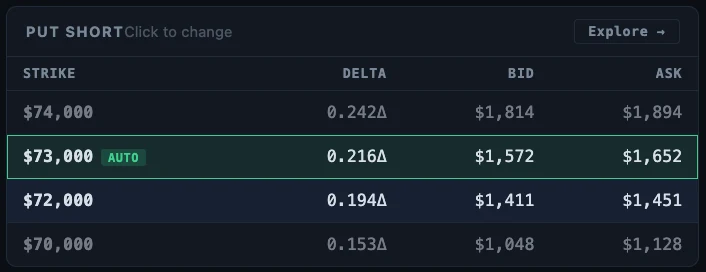
In this capture, the $73,000 put expiring December 25, 2026 is quoted at $1,572 bid and $1,652 ask, with the Bitcoin forward at $81,196.70. A buyer of a hedge pays the ask.
Hedging with spreads
Crypto options hedging with spreads works by selling a second option to pay for part of the first. There are two common ways to do it.
A put spread
You buy the put you want and sell a lower-strike put. The sold put brings in premium, which makes the hedge cheaper, but it ends your protection below the lower strike. A bear put spread is cheaper downside protection than a plain put, and it defines both the maximum gain and the maximum loss.
The trade-off is protection. A put spread only protects the range between its two strikes. Below the lower strike, the protection stops and your loss grows again. You trade some protection against a deep fall for a cheaper hedge.
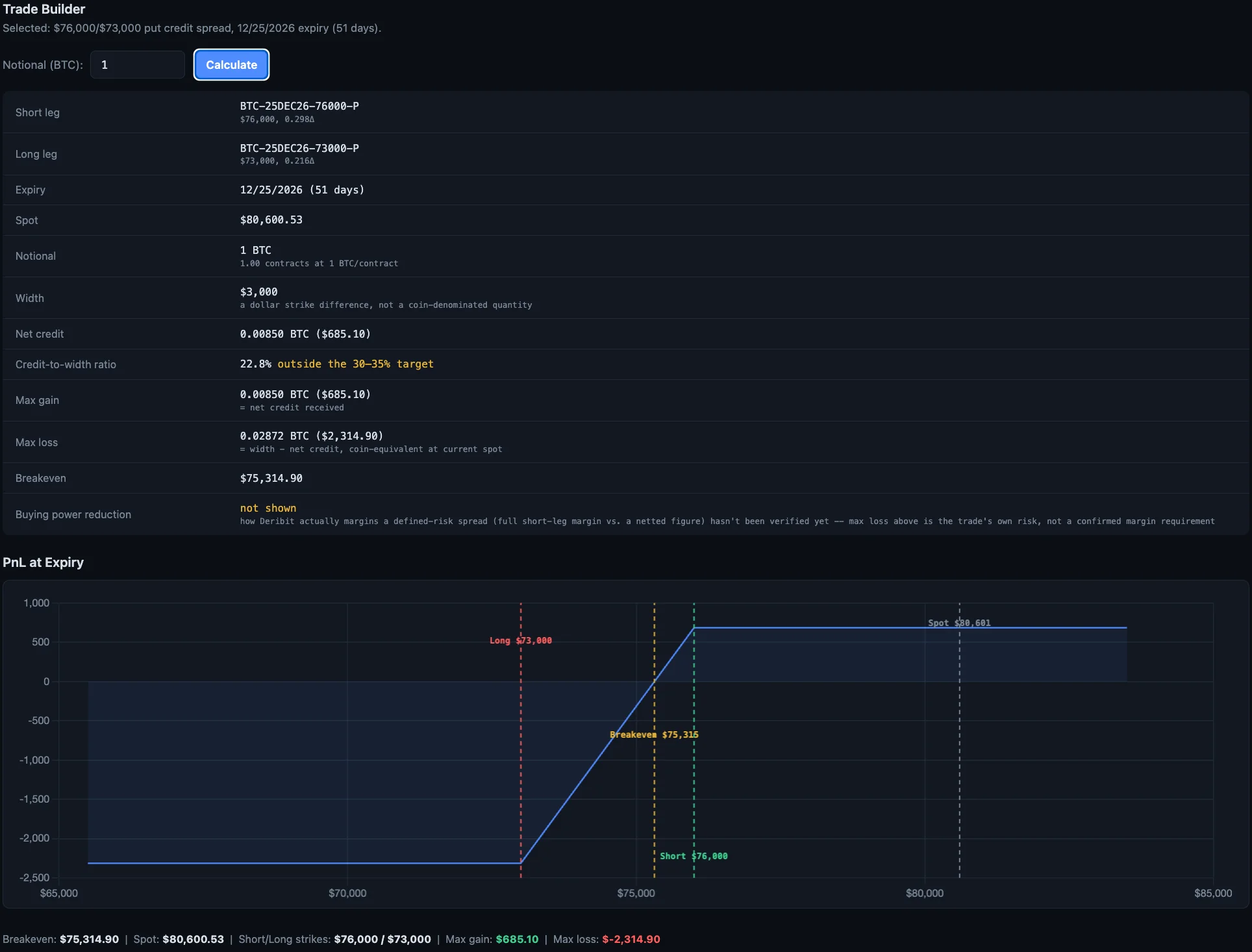
The Lesson 8 dashboard shows the sold version of a put spread. In this capture, a $76,000 and $73,000 put spread collects a credit of about $685 on a $3,000 width. A hedger who buys the same spread pays roughly that amount instead of receiving it, and the payoff flips. The protection starts at the higher strike, $76,000, and stops at the lower strike, $73,000, so the most the spread can pay is the $3,000 width, before the cost.
A collar
In a collar, you hold spot, buy a protective put, and sell a covered call to finance the put. The curriculum’s rule of thumb is to sell the call 10 to 15% above the current price. If the call premium covers the put, the collar costs nothing up front, and both a floor and a ceiling are defined. The price is that you give up the gains above the call strike.
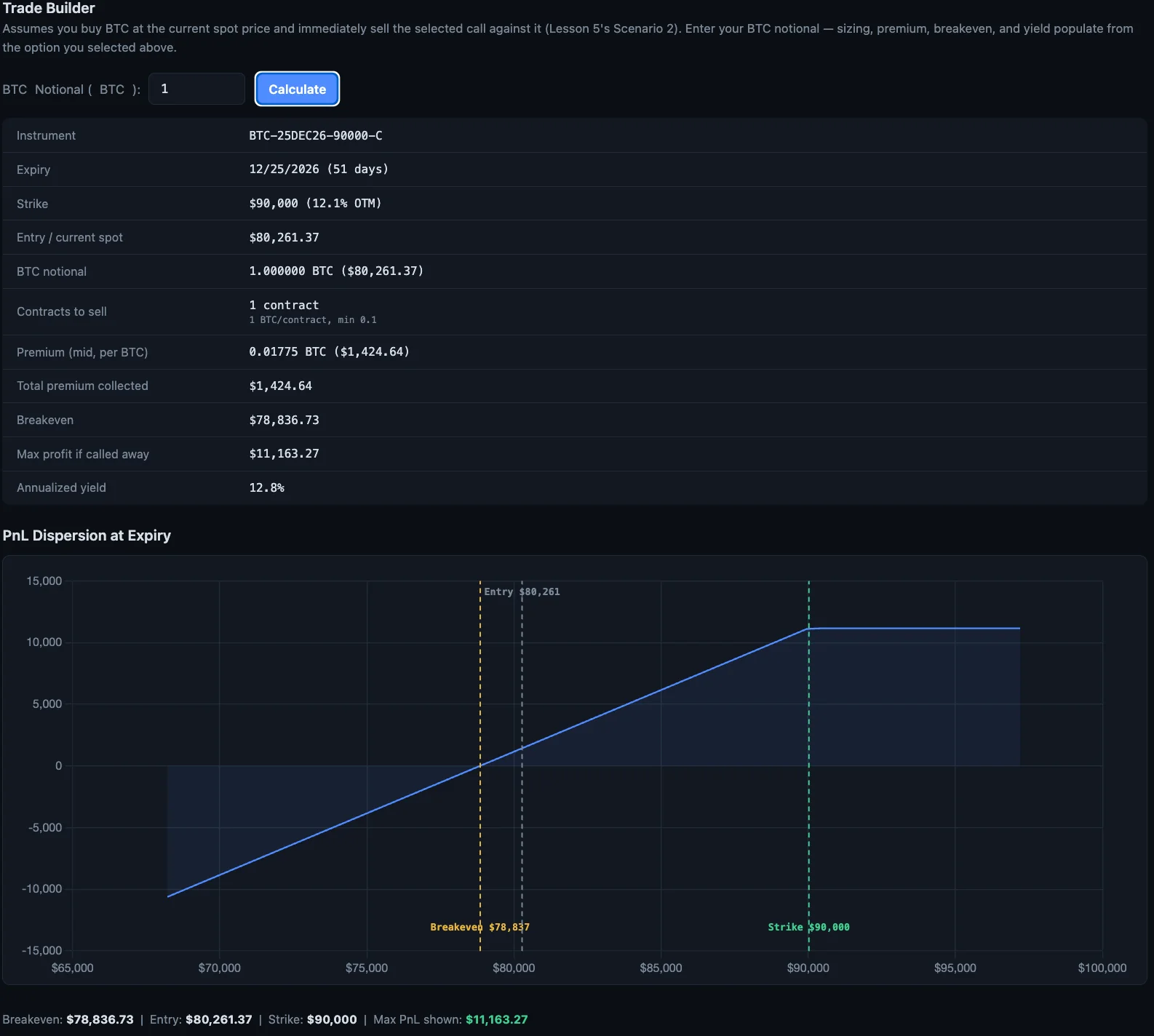
The call side of a collar is a covered call, which Lesson 5 teaches. In this capture, selling the $90,000 call against 1 Bitcoin collects about $1,425. A put such as the $73,000 put, quoted at $1,652 on the options board earlier on this page, would be the other half. The call premium pays for most of that put, and the price is that your gains stop at $90,000.
Hedging with futures
You can also hedge by shorting futures against your spot. If you hold Bitcoin and short an equal notional amount of a Bitcoin perpetual, your net price exposure is close to zero. If Bitcoin rises $1,000, your spot gains $1,000 and your short loses $1,000, and the reverse when it falls.
- No premium. You post margin on the short instead of paying for an option.
- You give up the upside. While the hedge is on, gains on your spot are offset by losses on the short.
- Funding. On a perpetual, a positive rate pays you as a short, and a negative rate costs you. Our guide to perpetual futures and funding rates explains it.
- Match the size exactly. The spot and the short should match in Bitcoin, not in dollars. A mismatch leaves some price exposure in place.
- Use isolated margin. It limits your risk to the margin you put on the short. Our margin, liquidation and risk management guide shows how to avoid liquidation on the short leg.
Hedge comparison table
| Protective put | Put spread | Collar | Short futures | |
|---|---|---|---|---|
| Cost | Premium, paid up front | A lower net premium | Little or no net premium | No premium. Margin and funding |
| Protection | A floor below the strike | A floor between two strikes only | A floor, with a ceiling on gains | Offsets price moves in both directions |
| Upside kept | All of it, less the premium | All of it, less the net premium | Up to the call strike | None while the hedge is on |
| Complexity | Low | Medium | Medium | Medium, because of margin and funding |
Our guide to crypto options trading covers puts, calls and spreads in more detail.
How much should I hedge?
The hedge ratio is the size of your hedge divided by the size of your holding. At 100%, the hedge offsets all of your price exposure. At 50%, it offsets half. If you hold 2 Bitcoin and short 1 Bitcoin of futures, your hedge ratio is 50%.
A full hedge removes most of the price risk but also most of the reason to hold the asset. A partial hedge lets you keep some upside and still limits the damage. How much to hedge depends on how much loss you can tolerate, how long the risk lasts and what the hedge costs. Match the expiry to the period you are worried about, such as a known event date, and size the hedge to the amount you actually hold.
Spot holders face no liquidation, but a crowded week can still swing prices hard. Decide before Friday’s jobs report what move would change your plan.
Leverage is where a gap hurts most. Volatility tends to build into election weeks, and this week also carries the jobs report, AMD and Arm earnings and Iran headlines. A common approach is to trade smaller and keep more distance from your liquidation price. Crypto and the oil contracts on exchanges like OKX trade through the weekend, so Sunday night can gap too.
Staying out is a position. Senate control may take days to settle and the jobs report lands Friday, so waiting for clarity is a reasonable choice.
Risks and limits of hedging
- Cost drag. Insurance has a price. If you buy puts repeatedly and they keep expiring worthless, the premiums add up and pull down your return. Options are also more expensive when implied volatility is high, which is often just before a known event.
- Basis. A futures hedge trades at a premium or discount to spot, so it is not a perfect match. It generally moves with the underlying asset, but the gap, and funding on a perpetual, can make the hedge and the holding drift apart.
- Under or over hedging. Any extra delta will make or cost you money, depending on your delta and the direction of the market. Check the size of both legs.
- Timing. An option expires. If the hedge ends before the risk does, you are unprotected, and you pay again to renew it.
- Margin and liquidation. A short futures leg needs margin and can be liquidated if it is not managed.
- Taxes and costs. Closing or rolling a hedge has trading costs. Tax treatment depends on your cost basis and domicile. This is not tax advice, so consult a professional.
Harmonic Academy’s options dashboards show a live options board from OKX and Deribit, a trade builder and a profit and loss at expiry chart for the strategies in Lessons 5, 8, 9 and 10. The board shows real premiums for the strikes and expiries you are considering. The lessons, the live lesson tools and the core curriculum are part of Harmonic Academy, along with the weekly briefs.
Frequently asked questions
How do I hedge my crypto?
You take a second position that gains when your holding falls. The main ways are buying a put option, using a put spread or a collar to lower the cost, or shorting futures against your spot holding. Each one trades protection against cost and complexity, and none removes risk entirely.
What is a protective put?
A protective put is a put option you buy while holding the underlying asset. It gives you the right to sell at the strike price, so if the price falls sharply, the put gains value and offsets the loss. If the price stays flat or rises, the put expires worthless, and the premium is the cost of the insurance.
How much does a protective put cost?
The cost is the premium, and it depends on the strike, the expiry and implied volatility. A put closer to the current price, with a longer expiry, or bought when volatility is high costs more. In Lesson 8’s quote, a 45-day put at a strike about 12% below the price costs about 1.5% of the position.
Can I hedge with futures instead of options?
Yes. You can short futures or a perpetual against your spot holding, which offsets price moves in both directions. There is no premium to pay, but you give up the upside while the hedge is on, and you take on margin and funding costs.
What is a hedge ratio?
A hedge ratio is the size of your hedge divided by the size of your holding. A 100% ratio offsets the price exposure completely, and a 50% ratio offsets half. The right ratio depends on how much downside you can tolerate and how much the hedge costs.
Does hedging remove all risk?
No. A hedge reduces one risk and usually adds a cost or a new risk. A put costs a premium that can expire worthless, a spread leaves part of the downside open, and a futures hedge adds margin and funding. A hedge that is too small or too large leaves extra delta, which can make or cost you money.
Go deeper in Harmonic Academy. The community has the weekly briefs, and the core curriculum, the lessons and the live lesson tools are there too.
Join Harmonic AcademyRelated guides
Education only. Not financial advice. Trading derivatives carries a high risk of loss. The figures on this page are illustrative and are not a prediction or a promise of any result.