Crypto Options Trading for Beginners: How Bitcoin and ETH Options Work
Education only. Not financial advice. Trading derivatives carries a high risk of loss.
Short answer
An option gives you the right, but not the obligation, to buy or sell an asset at a set price by a set date. A call is the right to buy, a put is the right to sell, and the premium is the price of that right. If you buy an option, the premium is the most you can lose.
How do crypto options work for beginners? You pick a direction, buy or sell a call or a put, and the price of that choice is the premium. Buyers have a capped loss. Sellers collect the premium and take on more risk. This guide to crypto options trading for beginners covers how Bitcoin options work, how to read a chain, the Greeks, and the main strategies.
- How Bitcoin options work
- ETH options
- How to read a Bitcoin options chain
- The Greeks explained
- Bitcoin implied volatility
- Bitcoin options expiry
- Bullish and bearish options strategies
- Credit spread strategy
- Covered calls and selling puts
- Iron condor and range-bound markets
- Crypto options calculator
- Risks
- FAQ
How Bitcoin options work
So how do Bitcoin options work? An option gives you the right, but not the obligation, to buy or sell an asset at a fixed price by a specific date. If you buy that right, your maximum loss is the premium you paid, with no liquidation and no margin call beyond it. Selling an option is a different position. It requires posting margin, and an uncovered short option can face the same liquidation risk as a futures trade.
- Call. The right to buy at the strike price. It is profitable if the price rises above the strike plus the premium you paid. It is a bullish instrument.
- Put. The right to sell at the strike price. It is profitable if the price falls below the strike minus the premium. It is a bearish instrument, or a way to protect a position.
- Strike price. The fixed price at which the option can be exercised.
- Expiry. The date the option expires. Crypto options expire weekly, monthly or quarterly.
- Premium. The cost of the option. It is influenced by the time to expiry, implied volatility, and how far the strike is from the current price.
Crypto options are almost always European style, which means they can only be exercised at expiry, and they are cash settled, so no coins change hands. An option is in the money when it has intrinsic value (a call with the price above the strike, a put with it below), at the money when the strike is about the price, and out of the money when it has no intrinsic value.
| Position | Maximum loss | Maximum gain |
|---|---|---|
| Long call (buy a call) | The premium paid | Unlimited, as the price rises above the strike |
| Long put (buy a put) | The premium paid | Grows as the price falls, down to zero |
| Short call (sell an uncovered call) | Unlimited, as the price rises above the strike | The premium collected |
| Short put (sell a put) | Grows as the price falls, down to the strike | The premium collected |
ETH options
ETH options use the same mechanics as Bitcoin options: calls, puts, strikes, expiries and premiums. The strategies in this guide are not Bitcoin-specific, and they work on any asset with a liquid options chain.
The differences are practical. ETH trades at a much lower price, and its strike grid is finer. Bitcoin strikes typically list in about $1,000 steps near the money for expiries 30 to 50 days out. Confirm the spacing, the contract size and the expiries on the exchange you use.
How to read a Bitcoin options chain
An options chain lists every available strike for a given expiry. The columns that matter are the strike, the bid and ask, the implied volatility, the open interest and the delta. Look for a reasonable gap between bid and ask and enough open interest, because illiquid options have wide spreads that eat into your return before the trade starts.
Example from Harmonic’s Module 3
A live chain for the July 31, 2026 expiry, 18 days away, with a forward price of $62,875.49.
| What to look at | The example | What it tells you |
|---|---|---|
| Strike nearest the price | $63,000 | This is the at-the-money strike |
| Call price (mark) | 0.0303 BTC, about $1,905 | Options on coin-margined venues are often quoted in Bitcoin |
| Put price (mark) | 0.0323 BTC, about $2,031 | The put costs slightly more than the call here |
| Delta | 0.51 for the call, −0.49 for the put | Both are close to 0.5, which confirms it is at the money |
| Implied volatility | 35.3% | Implied volatility rises as strikes move further from the money in both directions |
Harmonic Academy’s options dashboards show a live chain like this from OKX and Deribit, so you can see real prices for the strikes and expiries you are considering. The lessons, the live lesson tools and the core curriculum are part of Harmonic Academy, along with the weekly briefs.
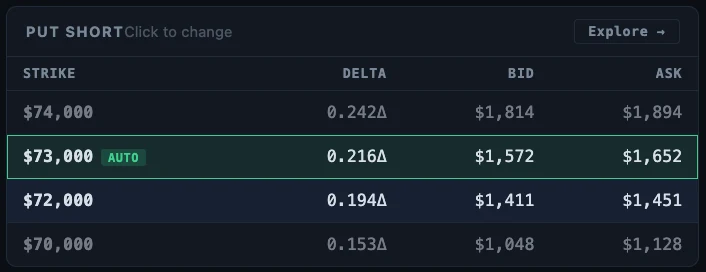
In this capture, for the December 25, 2026 expiry, the forward is $81,196.70 and at-the-money volatility is 36.66%. The $73,000 strike has a 0.216 delta, with a bid of $1,572 and an ask of $1,652.
The Greeks explained
These are the options Greeks explained for crypto traders. The Greeks describe how an option’s price changes as conditions change.
| Greek | What it measures | What it means for you |
|---|---|---|
| Delta | How much the option’s price moves for a $1 move in the underlying. It runs from 0 to 1 for calls and −1 to 0 for puts | An at-the-money call has a delta of about 0.5, so it gains about $0.50 for every $1 Bitcoin rises |
| Gamma | How fast delta changes as the price moves. It is highest at the money | The option’s sensitivity accelerates as it moves into the money. That is powerful but fast moving |
| Theta | Time decay. The option loses value every day as expiry approaches, all else equal | Theta hurts buyers and helps sellers, and it accelerates as expiry nears |
| Vega | Sensitivity to implied volatility | A high-vega option gains value when volatility spikes, which is common before major events |
Delta also gives a rough read on probability. A 20-delta put is priced as if there is about a 20% chance Bitcoin ends below that strike at expiry. That is why option sellers often choose strikes by delta.
Bitcoin implied volatility
Bitcoin implied volatility is the market’s expectation of future price movement, built into the option’s premium. High implied volatility means expensive options, and low means cheap ones.
Vega makes crypto options expensive before major events and cheap after them. Selling options after a spike in volatility can be profitable even if the price barely moves, while buying into a spike means paying a high price that can collapse. Our guide to trading strategies shows how market regime points to a strategy.
Bitcoin options expiry
Bitcoin options expiry is when the contract ends and settles. Options are cash settled, so an in-the-money option pays out the difference between the strike and the settlement price, and an out-of-the-money option expires worthless. Both major exchanges settle at around 08:00 UTC, using an index price averaged over a short window into that moment.
Expiries come weekly, monthly and quarterly. Deribit’s quarterly expiry falls on the last Friday of March, June, September and December.
Max pain is the price level at which the largest total number of option contracts would expire worthless, which means option sellers make the most money. Price sometimes gravitates toward max pain before a major expiry as dealers adjust their hedges. It is not a rule. At the June 2026 quarterly expiry, about $10.6 billion settled at 8am UTC with Bitcoin at $59,300, roughly 25% below the $74,000 max pain level.
Bullish and bearish options strategies
The settings below come from Harmonic’s lessons. Treat them as education.
| Strategy | View | What you do | Shape of the risk |
|---|---|---|---|
| Short put | Bullish | Sell a put and collect the premium, at 16 to 22 delta and 35 to 50 days out | Gain is the premium. Loss grows below the strike |
| Short put credit spread | Bullish | Sell a put and buy a further out put. The short strike is closer to the money, at 25 to 35 delta | Defined: the width minus the credit |
| Jade lizard | Bullish | A short put plus a short call spread above the market, with enough premium to cover the spread’s width | Defined on the upside. Loss grows below the put strike |
| Short call credit spread | Bearish | Sell a call closer to the money and buy a further out call | Defined: the width minus the credit |
| Unbalanced iron condor | Bearish | A put spread plus a call spread up to twice as wide, with enough total credit against the put spread’s width | Defined on both sides, with more risk on the upside |
These are bullish options strategies for Bitcoin and bearish options strategies for Bitcoin. They all collect premium and rely on time decay, so they are income strategies and not bets on a big move. The lessons take profit once about half of the credit is captured, because the last half is the slowest and riskiest to collect.
Bearish structures
The bearish structures come from Harmonic’s Lesson 9. A short call credit spread sells a call and buys a higher call to cap the risk. You keep the credit if Bitcoin finishes below the short strike, and the most you can lose is the width minus the credit.
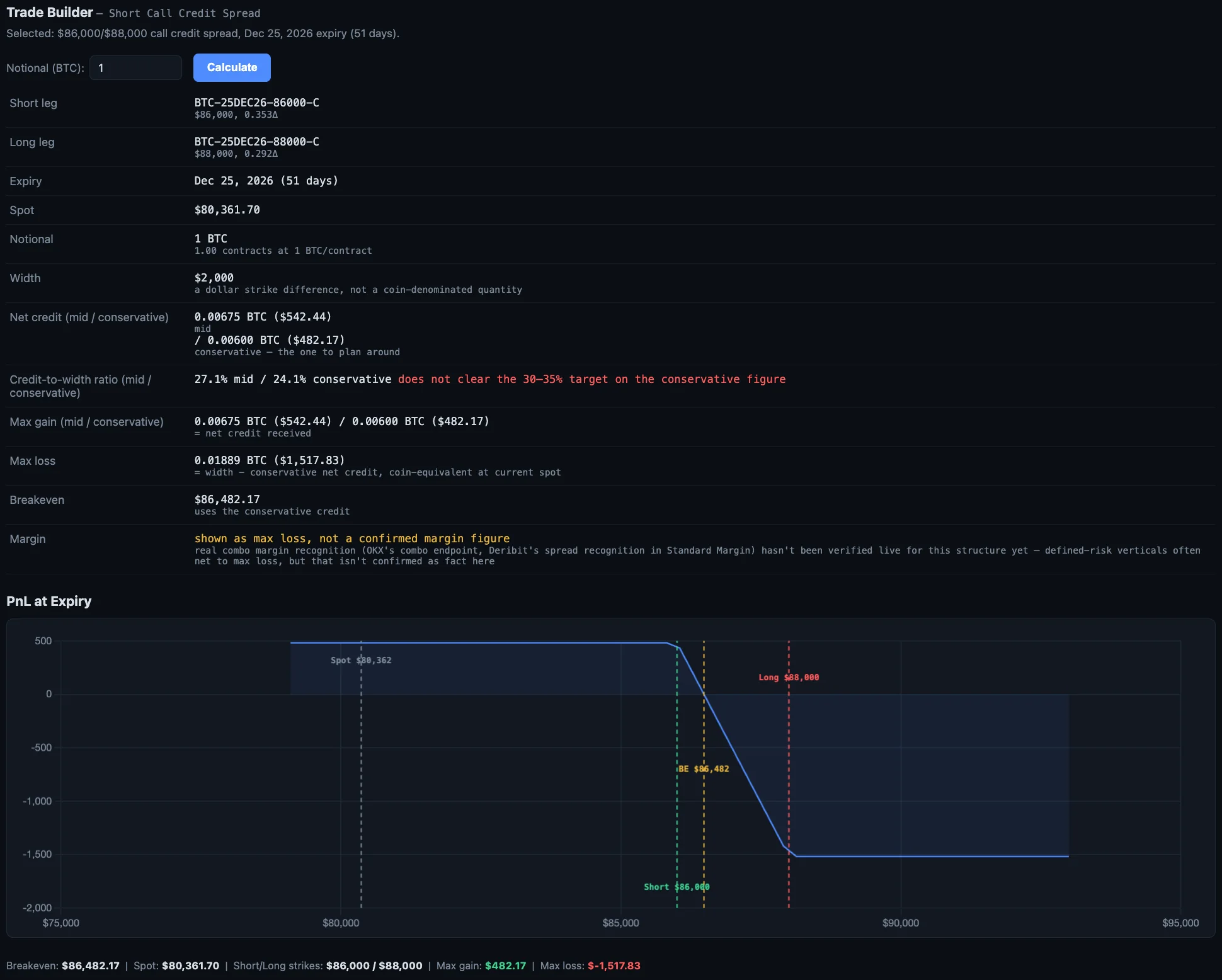
In this capture, an $86,000 and $88,000 call credit spread expiring December 25, 2026, with Bitcoin at $80,361.70, has a mid credit of about $542 and a conservative credit of $482.17 on a $2,000 width. The maximum loss is $1,517.83 and the break-even is $86,482.17. The dashboard flags that the conservative credit is 24.1% of the width, against the 30 to 35% target, and none of the 8 candidate combinations with this short call clear the target today.
Unbalanced iron condor. This structure adds a put spread below the market to a call spread, so the put premium helps pay for the call side. The call spread is up to twice as wide as the put spread, so the risk is larger on the upside than on the downside, which is what makes it bearish. The dashboard checks that the total credit is at least 50% of the put spread’s width.
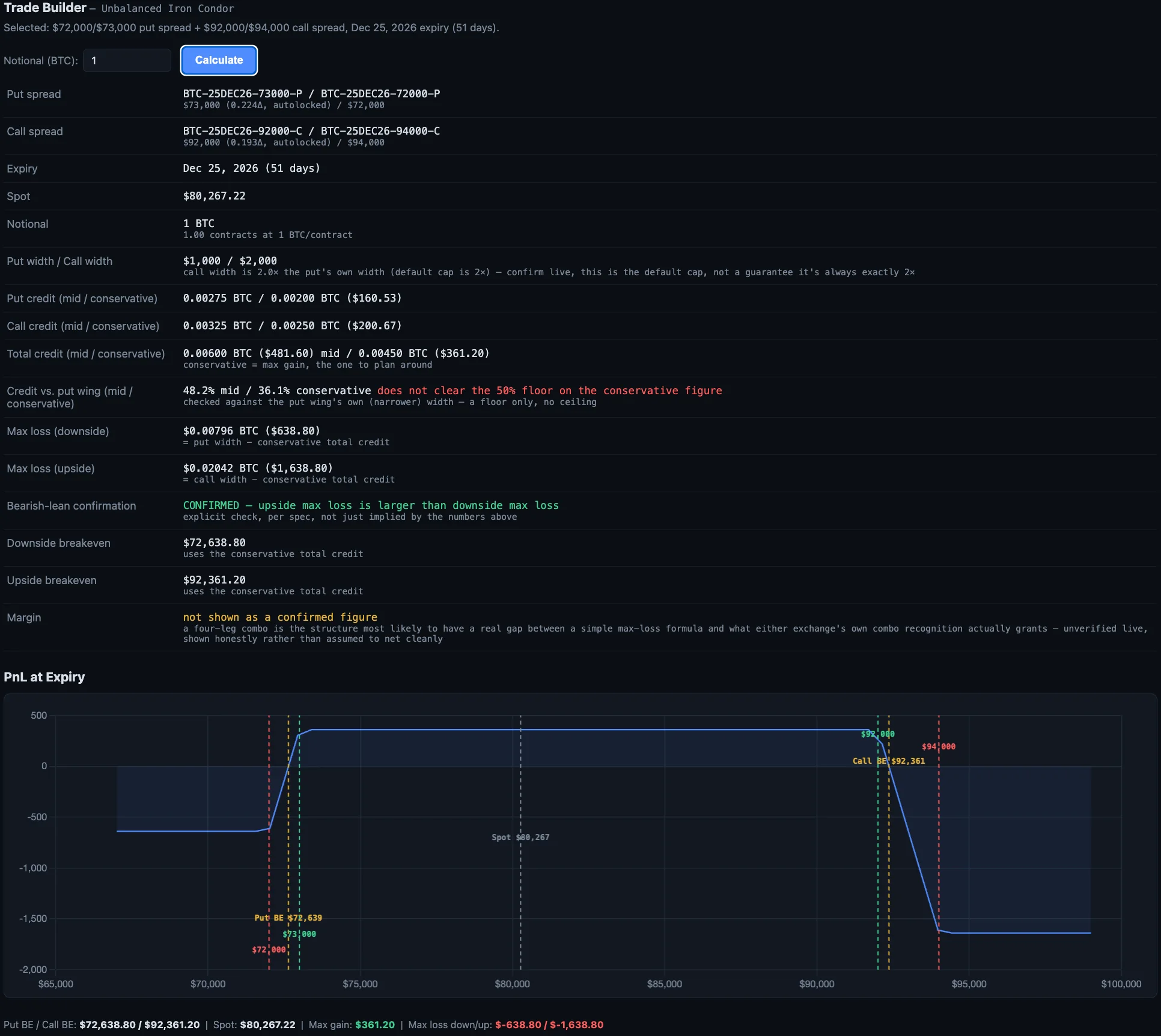
In this capture, a $73,000 and $72,000 put spread with a $92,000 and $94,000 call spread, expiring December 25, 2026, collects a conservative total credit of $361.20, or $481.60 at the mid. The call spread is $2,000 wide, twice the $1,000 put spread, so the maximum loss is $1,638.80 on the upside and $638.80 on the downside. The break-evens are $72,638.80 and $92,361.20. The dashboard confirms the bearish lean and flags that the conservative credit is 36.1% of the put spread’s width, against the 50% floor.
Credit spread strategy
A credit spread strategy sells one option and buys a further out option of the same type, for a net credit. The long option caps your loss. A short put credit spread is bullish. A short call credit spread is its bearish mirror.
Example from Harmonic’s Lesson 8
Bitcoin has pulled back to about $77,000 and implied volatility has jumped. You believe $68,000 is a level Bitcoin holds, and you have 45 days to expiry. You sell the $72,000 put and buy the $70,000 put, and you collect about $687 net, or 0.0089 BTC.
- Maximum gain: the $687 credit.
- Width: $72,000 − $70,000 = $2,000. The credit is 34.4% of the width.
- Maximum loss: $2,000 − $687 = $1,313, about 0.0171 BTC.
- Break-even: $72,000 − $687 = $71,313.
The short strike sits around 32 delta, closer to the market than a deep strike would be. It was chosen so a $2,000-wide spread can collect the lesson’s 30 to 35% target.
| Bitcoin at expiry | Result of the spread |
|---|---|
| $77,000 (where it started) | +$687 |
| $72,000 (short strike) | +$687 |
| $71,313 (break-even) | $0 |
| $71,000 | −$313 |
| $70,000 (long strike) | −$1,313 |
| $65,000 | −$1,313 |
You keep the full credit if Bitcoin finishes at or above $72,000. Between $72,000 and $70,000 you lose part of it, and below $70,000 your worst case is fixed at $1,313, no matter how far Bitcoin falls. The risk is known at the start.
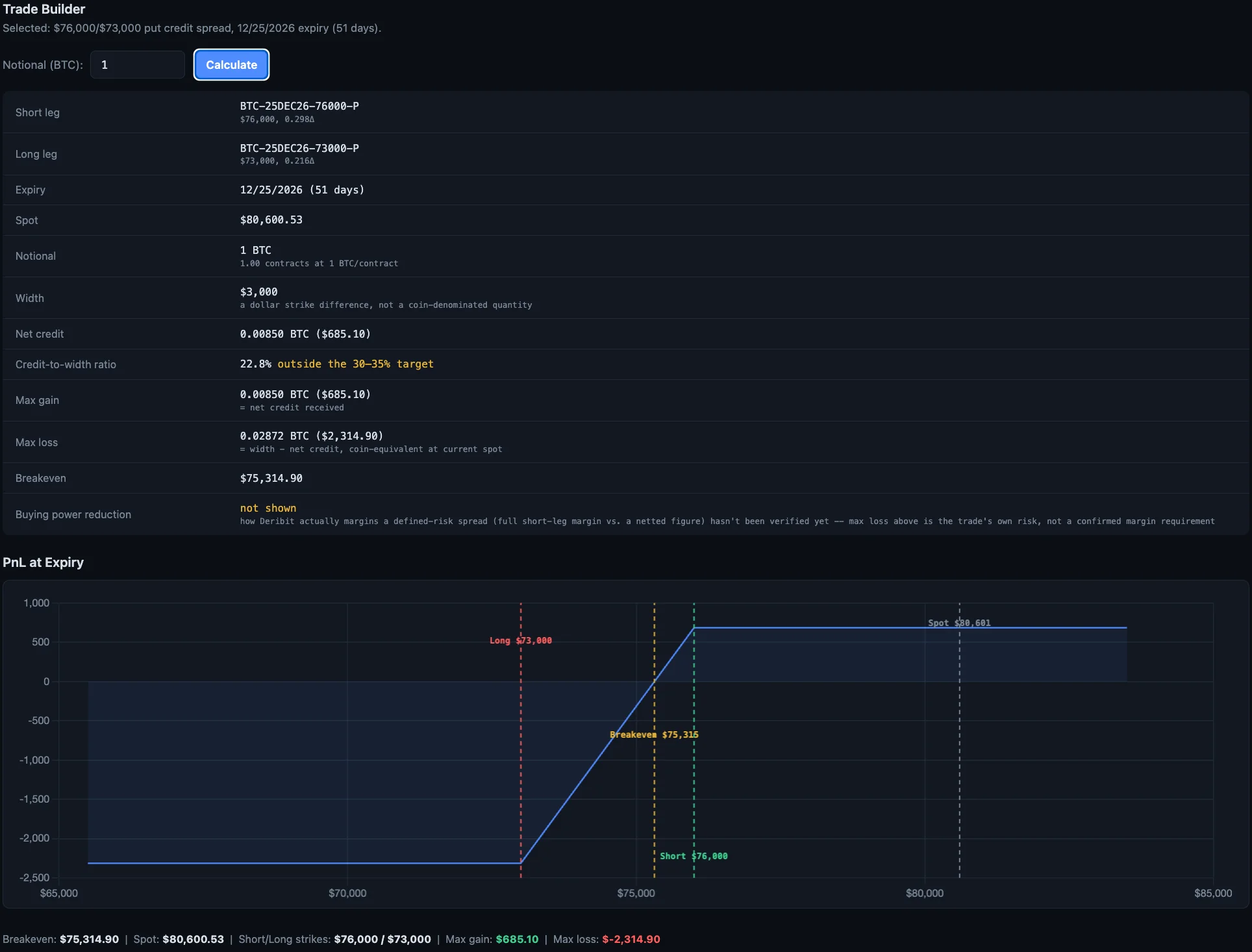
In this capture, a $76,000 and $73,000 put credit spread expiring December 25, 2026 collects a net credit of about $685 on a $3,000 width. The maximum loss is $2,314.90 and the break-even is $75,314.90. The dashboard flags that the credit is 22.8% of the width, against the 30 to 35% target.
Covered calls and selling puts
Covered call
The covered call Bitcoin strategy is one of the simplest options strategies. You hold Bitcoin and sell someone the right to buy it from you at a higher price. They pay you cash today for that right, and it is yours to keep. If Bitcoin stays below your strike, you keep your coin and the premium. If it rallies through the strike, your coin is called away at that price, and your gain is capped there.
The curriculum’s starting point is to sell a call 10 to 15% above the current price with 30 to 60 days to expiry. In Lesson 5’s example, with Bitcoin at $62,500, a $70,000 call about 54 days out paid roughly $1,200 per Bitcoin. That is about 1.9% of the price, or roughly 13% annualized. One call covers one Bitcoin, so sell no more calls than the coins you hold.
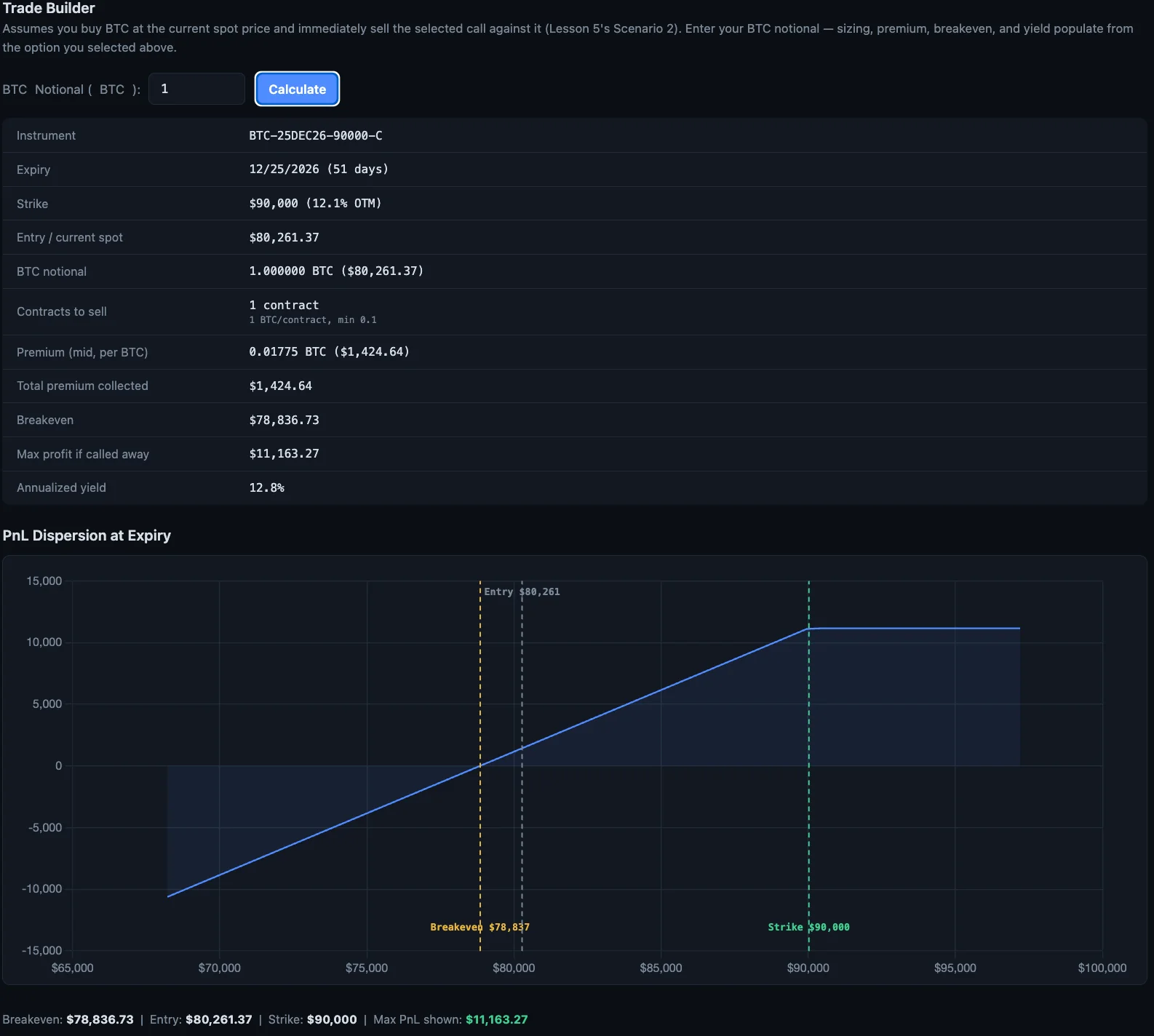
In this capture on Deribit, buying 1 BTC at $80,261.37 and selling the $90,000 call, which is 12.1% above the price and expires December 25, 2026, collects about $1,424.64. The break-even is $78,836.73, the most you can make if the call is exercised is $11,163.27, and the dashboard shows an annualized yield of 12.8%.
Selling puts
How to sell puts on Bitcoin comes down to one promise. A short put commits you to pay the buyer the cash difference if Bitcoin settles below your strike at expiry. You are paid up front for taking that obligation. If Bitcoin finishes at or above the strike, the put expires worthless and you keep the whole premium.
Choose a strike below the market, at a price where you would be comfortable owning Bitcoin. Lesson 8 uses a 16 to 22 delta put with 35 to 50 days to expiry, and takes profit once about half of the premium is captured.
Example from Harmonic’s Lesson 8
With Bitcoin around $77,000 and 45 days to expiry, you sell the $68,000 put and collect 0.0149 BTC, about $1,146. Your break-even is $66,854. If Bitcoin holds above $68,000, you keep the full premium. If it settles at $60,000, you pay the buyer about 0.1333 BTC, the $8,000 of value at that price, and after the premium you are left at roughly −0.1184 BTC, about −$7,106. No Bitcoin changes hands. It is a cash payment.
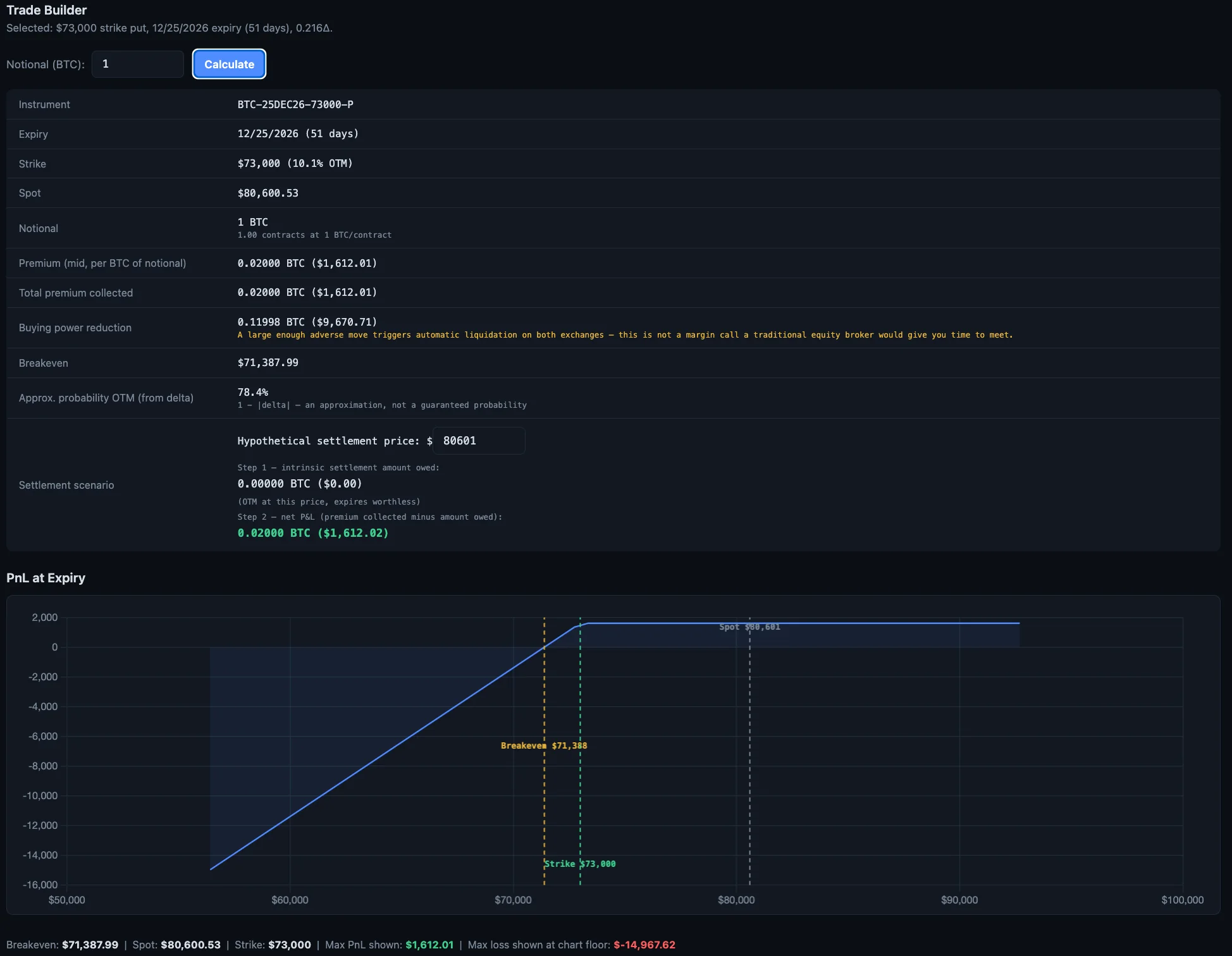
In this capture, selling the $73,000 put that expires December 25, 2026, with Bitcoin at $80,600.53, collects about $1,612. The break-even is $71,387.99, and the dashboard estimates a 78.4% chance of finishing out of the money from the 0.216 delta, an approximation. The chart shows a flat gain above the strike and a loss that grows below the break-even.
What can go wrong
A covered call does not protect you if Bitcoin falls significantly. The premium softens the loss but does not remove it, so it is an income strategy and not a hedge. A short put loses more the further Bitcoin falls below the strike, and an uncovered short option can carry unlimited or very large losses. Our guide to margin, liquidation and risk management explains how margin works on short options.
Iron condor and range-bound markets
If you are wondering how to trade a range bound market in crypto, the crypto iron condor strategy is the standard answer. You sell a put spread below the current price and a call spread above it, both the same width. You get paid if Bitcoin stays between your two short strikes through expiry, and you do not care which side it would have broken. It is a different belief from the bullish or bearish strategies, because you are not betting on a direction. A balanced iron condor is symmetric: the same width on both sides, at a similar distance from the price.
The maximum gain is the net credit, and the maximum loss is the width of one spread minus the credit. The long wings define the risk, which is why it is the preferred structure for most retail traders selling premium in a sideways market.
| Iron condor | Jade lizard | |
|---|---|---|
| Structure | A put spread and a call spread, four options | A short put and a short call spread, three options |
| Market view | Neutral. The price stays in a range | Neutral to mildly bullish |
| Risk | Defined on both sides | Defined on the upside, open below the put strike |
Example from Harmonic’s Lesson 10
Checked live on OKX, 43 days out, with Bitcoin at $76,297.70. You sell the $70,000 put (22 delta) and buy the $66,000 put. You sell the $84,000 call (24 delta) and buy the $88,000 call. Both wings are $4,000 wide.
- Credit: 0.01525 BTC ($1,163.54) at the mid price, which is 29.1% of the width. Priced the conservative way, short bid minus long ask, it is 0.01400 BTC ($1,068.17), or 26.7%.
- Maximum loss: $2,931.83 on either side, which is what “balanced” looks like.
- Break-evens: $68,931.83 on the downside and $85,068.17 on the upside. You keep the full credit between $70,000 and $84,000.
In Lesson 8, the jade lizard keeps the $68,000 short put and adds a short $84,000 and long $85,000 call spread for about $191. The total premium of about $1,337 exceeds the $1,000 call spread width, so there is no upside loss, and the downside break-even moves to $66,663.
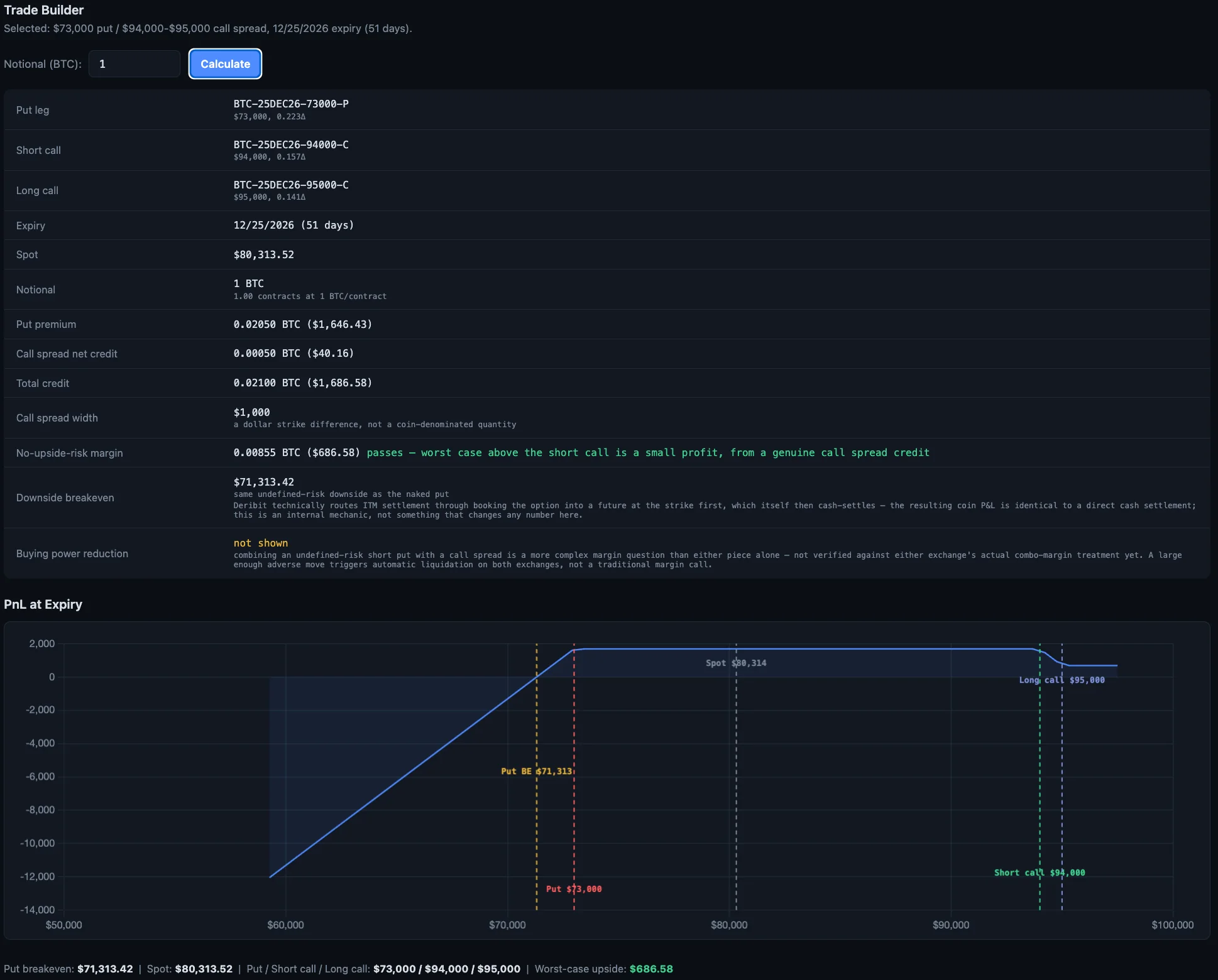
In this capture, a $73,000 short put plus a $94,000 and $95,000 call spread collects $1,686.58 in total, with a downside break-even of $71,313.42. A jade lizard is meant to collect more than the call spread’s width, so there is no loss on the upside. Here the call spread is $1,000 wide, so the dashboard shows the rule passing, with a worst-case upside gain of $686.58.
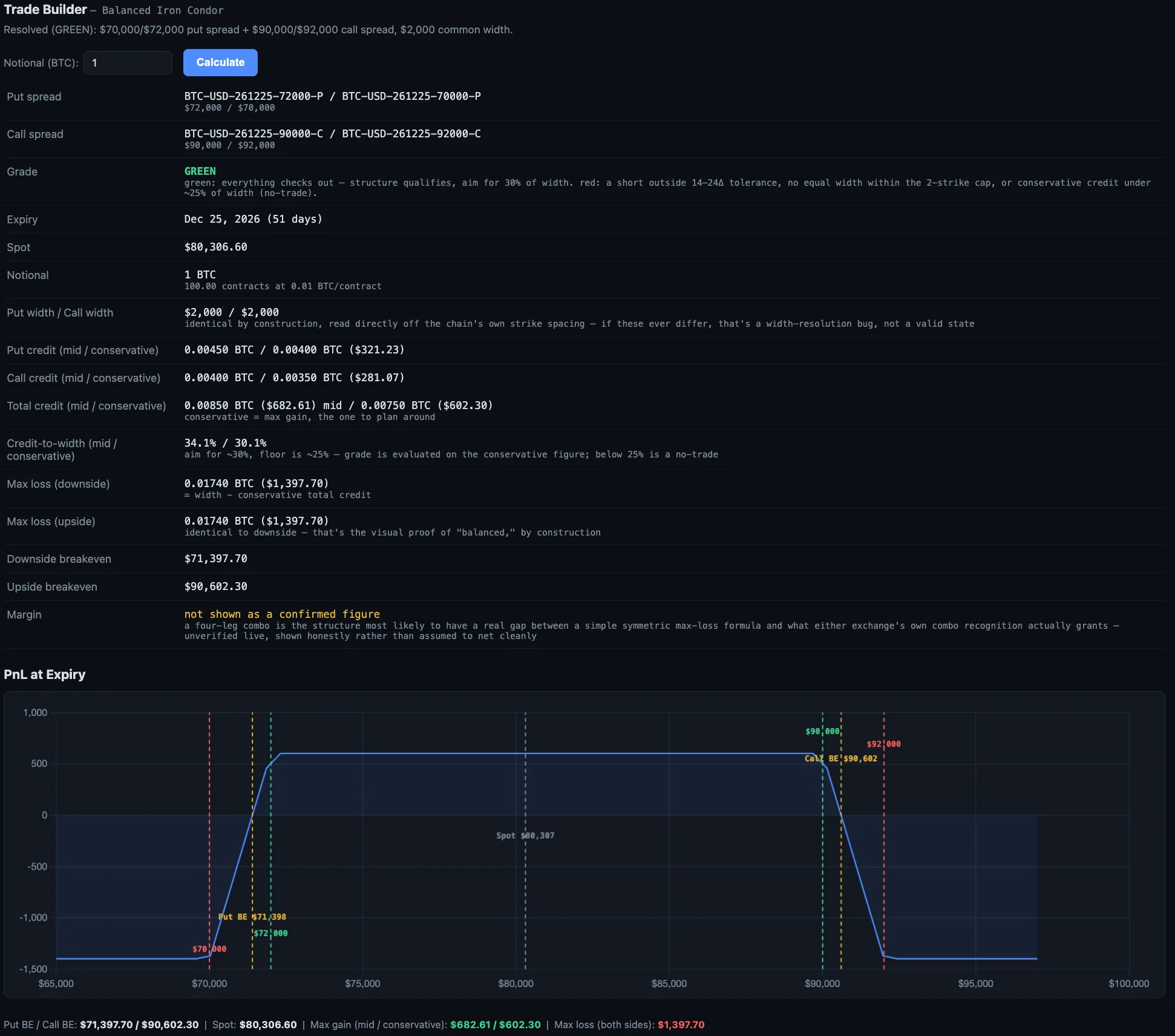
In this capture, a balanced iron condor with $2,000 wings, the $72,000 and $70,000 puts and the $90,000 and $92,000 calls expiring December 25, 2026, has a conservative credit of $602.30, which is 30.1% of the width. The dashboard grades it green. The maximum loss is $1,397.70 on either side, and the break-evens are $71,397.70 and $90,602.30.
Crypto options calculator
A crypto options calculator shows what a trade pays at expiry before you place it. Harmonic Academy’s options dashboards include a trade builder and a profit and loss at expiry chart for the strategies in Lessons 5, 8, 9 and 10. You pick the expiry and strikes from the live board, add the legs and the size, and the builder shows the premium and the result at expiry.
The credit spread example above is the kind of result a calculator gives you: a maximum gain of $687, a maximum loss of $1,313, and a break-even at $71,313. Always check those three numbers before you enter.
Risks
| Risk | Strategies |
|---|---|
| Defined: you know the worst case | Buying a call or a put (the premium), credit spreads (the width minus the credit), iron condors (one spread’s width minus the credit) |
| Partly defined | Covered calls (the coin can still fall) and jade lizards (open below the put strike) |
| Undefined | Uncovered short calls (unlimited) and short puts without cash or an offsetting leg (large, down to the strike) |
- Total loss of premium. A long option can lose its whole premium.
- Selling risk. A spread carries defined but real risk equal to the width minus the credit. Selling naked options, without an offsetting leg or a holding, carries unlimited loss potential.
Frequently asked questions
How do Bitcoin options work?
A Bitcoin option is a contract that gives the buyer the right, but not the obligation, to buy or sell Bitcoin at a fixed strike price by an expiry date. The buyer pays a premium, and that premium is the most the buyer can lose. Crypto options are usually European style and cash settled, so they are exercised only at expiry and no coins change hands.
What is the difference between a call and a put?
A call is the right to buy at the strike price, so it gains value when the price rises. A put is the right to sell at the strike price, so it gains value when the price falls. Calls express a bullish view, and puts express a bearish view or protect a position you hold.
What does delta mean in options trading?
Delta measures how much an option’s price moves for a $1 move in the underlying asset. An at-the-money call has a delta of about 0.5, so it gains roughly $0.50 when Bitcoin rises $1. Delta also roughly approximates the market’s odds that the option finishes in the money.
What is implied volatility?
Implied volatility is the market’s expectation of future price movement, built into the option’s premium. High implied volatility makes options expensive and low implied volatility makes them cheap. It tends to rise before major events and fall after they pass.
What is a credit spread?
A credit spread means selling one option and buying a further out-of-the-money option of the same type, for a net credit. The long option caps your maximum loss at the width between the strikes minus the credit you received. You keep the whole credit if the price stays on the right side of your short strike at expiry.
What is an iron condor and how is it different from a jade lizard?
An iron condor combines a put spread below the price and a call spread above it, so it profits if the price stays between the short strikes, and its risk is defined on both sides. A jade lizard combines a short put with a short call spread, so its risk is defined on the upside but not on the downside.
What is a covered call on Bitcoin?
A covered call means you hold Bitcoin and sell a call option against it, collecting the premium. If Bitcoin stays below the strike, you keep your coin and the premium, and if it rallies through the strike, your gain is capped at that level. It generates income, but it does not protect you if the price falls sharply.
How do I sell puts on Bitcoin?
You sell a put at a strike below the current price and collect a premium up front. If Bitcoin settles above the strike at expiry, you keep the whole premium. If it settles below, you pay the cash difference between the strike and the settlement price, so the position carries real risk and needs margin or cash set aside.
Go deeper in Harmonic Academy. The community has the weekly briefs, and the core curriculum, the lessons and the live lesson tools are there too.
Join Harmonic AcademyRelated guides
Education only. Not financial advice. Trading derivatives carries a high risk of loss. The figures on this page are illustrative and are not a prediction or a promise of any result.